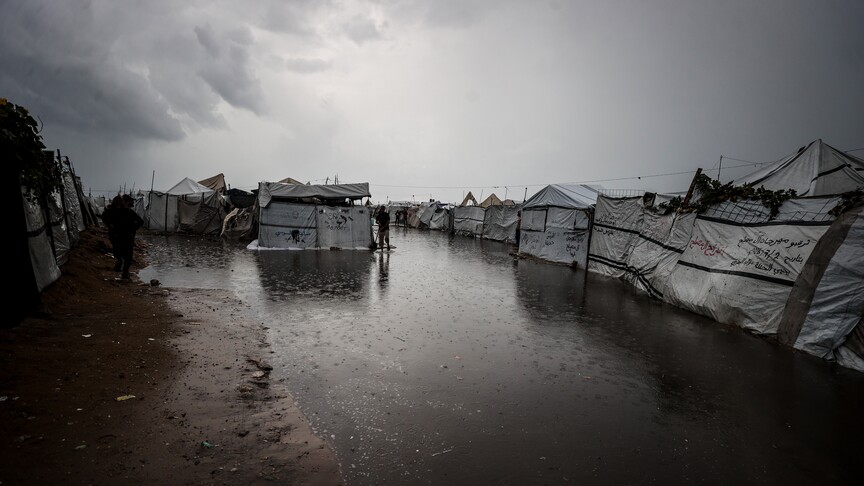
A sand cliff on a shelter in Deir al-Balah collapsed on Sunday evening, killing five Palestinians, including three children, as reported by Gaza’s Civil Defense. The tragedy followed a severe rainstorm that had already washed away tents for thousands of displaced families in the central Gaza Strip.
Gaza's Civil Defense spokesperson Mahmoud Basal said the cliff fell onto tents at a shelter center due to heavy rainfall. He noted that the collapse killed five people—three children and a woman—and left several others seriously injured.
Rescue teams continue to search for missing people, according to Basal. The search is ongoing as officials try to locate any survivors trapped beneath the collapsed tents or buried by the falling sand.
Earlier, a low‑pressure weather system that struck the Gaza Strip had already flooded about 70,000 tents, an incident that exposed the harsh conditions faced by displaced families. The flood, described by authorities, worsened the already difficult living conditions in the area.
Civil Defense officials have described the situation as a “catastrophic failure” of the makeshift shelter infrastructure, which had already been under strain from the recent influx of refugees. The collapse underscores the vulnerability of temporary housing when exposed to extreme weather.
In the days following the flood, officials highlighted the need for stronger, more resilient shelter designs that could withstand sudden saturation and erosion. The Civil Defense pointed out that the tents, many of which were set up hastily, lacked adequate anchoring and drainage systems.
International aid agencies have called for increased funding for durable shelter materials and for the installation of protective measures, such as sand barriers and reinforced foundations, to prevent such collapses in the future.
While rescue operations continue, questions remain about the exact cause of the collapse, the structural integrity of the tents, and the adequacy of emergency response plans in the region. Gaza's Civil Defense is working with local agencies to conduct a post‑incident review.
For residents, the incident has highlighted the ongoing risks posed by extreme weather to an already fragile community. The Civil Defense has urged all affected families to remain vigilant and seek safer shelters if possible.
Officials predict that the region’s weather pattern is likely to remain volatile, prompting ongoing vigilance and the preparation of emergency measures. The ongoing rescue operation and review of shelter safety protocols will likely shape the region’s response strategy for the coming weeks.