India's Supreme Court has recently revisited its controversial directive concerning stray dogs in Delhi and surrounding areas, a decision that has been met with significant public dissent. In a new ruling from a three-judge bench, the court has shifted away from an earlier ultimatum that mandated the collection of all stray dogs for shelter confinement. Instead, it now stipulates that stray dogs who are non-aggressive and free from rabies can be vaccinated, sterilized, and subsequently released back to their original locations.
This ruling marks a change from an earlier decision made on August 11, where concerns arose over an uptick in dog-related bites and rabies cases, prompting a call for more drastic measures. Historically, India has struggled with a considerable stray dog population, estimated at around one million in Delhi alone, contributing to a significant percentage of rabies fatalities globally.
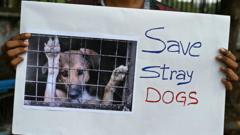
The prior ruling had faced criticism from various animal welfare organizations, which advocated for less severe actions, such as vaccination and neuter programs, rather than fulfilling an order that could lead to severe overcrowding in shelters and potential culling of animals. Following these protests, the Supreme Court established a three-judge panel to reassess the situation.
In light of the recent decision, the court also issued an initiative banning the feeding of stray dogs in public spaces unless in designated areas, aiming to mitigate conflicts between stray populations and human interactions. Additionally, it has made provisions for individuals keen on adopting strays, although it reinforced that these animals should not be returned to the streets.
The Supreme Court has further outlined plans to create a national policy addressing the welfare and management of stray dogs, acknowledging the complexity of the issue as cases arise from various states throughout the country. Moving forward, the court has made it clear that any public feeding of stray dogs will be monitored, and violations may lead to repercussions for animal welfare groups that do not comply with judicial directives.