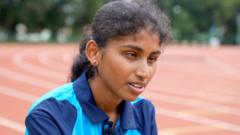
In a remote southern Indian village, Rakshitha Raju, now 24, recalls the harsh words of her childhood: "She is blind, she is a waste." Yet, she has shattered these perceptions, emerging as a leading middle-distance para athlete. "It makes me so proud," she asserts. Rakshitha lost her parents at a young age, raised by her grandmother, who is hearing and speech impaired. This shared understanding of disability fostered a unique bond between them.
Her journey began at 13, when a sports teacher recognized her potential and explained the concept of a guide runner. Initially, she relied on peers, but in 2016, during the National Games, she crossed paths with Rahul Balakrishna. Having previously competed in middle-distance events, Rahul naturally stepped into both coach and guide roles for Rakshitha, a choice driven by a shortage of guides in para sports.
Investment in their training was mutual; Rahul helped Rakshitha relocate to Bangalore for better opportunities, dedicating his resources to her growth. They face the challenge of training without physical contact, using only a tether to navigate the track together. "It's the small things that matter," he shares, highlighting the need for constant communication during races. This partnership solidified their bond with Rakshitha admitting, "I believe in my guide runner more than myself."
Together, they achieved remarkable success, winning gold medals at both the 2018 and 2023 Asian Games. As they returned triumphantly to Rakshitha’s village, the same community that once ridiculed her celebrated her victories with cheers and processions.
Their Paralympic journey brought them to compete in Paris 2024, where Rakshitha became the first blind Indian woman to qualify for the 1500m. While they fell short of a medal, another visually impaired athlete, Simran Sharma, secured bronze as a sprinter, highlighting the growing presence of Indian athletes with disabilities on the world stage.
Simran’s journey reflects similar challenges. Initially competing alone, she eventually found a guide in Abhay Kumar, but not without difficulties. Despite competing together for a short time, they faced disqualification in their first race. However, they quickly learned to sync, culminating in a bronze medal win in the 200m and becoming the first Indian woman with a visual impairment to podium in the Paralympics.
Challenges remain, especially for guide runners like Rahul and Abhay. Although they receive medals for their athletes’ achievements, the denial of long-term support raises concerns about their futures. The Paralympic Committee of India acknowledges the limitations, focusing on short-term assistance rather than sustainable career paths.
Both Rakshitha and Simran now enjoy sponsorships that fund their training, which they utilize to pay their guides. However, there is a collective desire for more systemic support for guide runners, who play an integral role in these athletes’ successes.
As they look towards future competitions, the drive to continue breaking barriers remains. Rakshitha and Rahul aim for gold in the next Paralympic Games, feeling a shared responsibility to serve as role models for disabled youth across India. With the recognition of their accomplishments and the celebration of women in sports, Rakshitha proudly represents a new wave of inspiration for future generations.
Her journey began at 13, when a sports teacher recognized her potential and explained the concept of a guide runner. Initially, she relied on peers, but in 2016, during the National Games, she crossed paths with Rahul Balakrishna. Having previously competed in middle-distance events, Rahul naturally stepped into both coach and guide roles for Rakshitha, a choice driven by a shortage of guides in para sports.
Investment in their training was mutual; Rahul helped Rakshitha relocate to Bangalore for better opportunities, dedicating his resources to her growth. They face the challenge of training without physical contact, using only a tether to navigate the track together. "It's the small things that matter," he shares, highlighting the need for constant communication during races. This partnership solidified their bond with Rakshitha admitting, "I believe in my guide runner more than myself."
Together, they achieved remarkable success, winning gold medals at both the 2018 and 2023 Asian Games. As they returned triumphantly to Rakshitha’s village, the same community that once ridiculed her celebrated her victories with cheers and processions.
Their Paralympic journey brought them to compete in Paris 2024, where Rakshitha became the first blind Indian woman to qualify for the 1500m. While they fell short of a medal, another visually impaired athlete, Simran Sharma, secured bronze as a sprinter, highlighting the growing presence of Indian athletes with disabilities on the world stage.
Simran’s journey reflects similar challenges. Initially competing alone, she eventually found a guide in Abhay Kumar, but not without difficulties. Despite competing together for a short time, they faced disqualification in their first race. However, they quickly learned to sync, culminating in a bronze medal win in the 200m and becoming the first Indian woman with a visual impairment to podium in the Paralympics.
Challenges remain, especially for guide runners like Rahul and Abhay. Although they receive medals for their athletes’ achievements, the denial of long-term support raises concerns about their futures. The Paralympic Committee of India acknowledges the limitations, focusing on short-term assistance rather than sustainable career paths.
Both Rakshitha and Simran now enjoy sponsorships that fund their training, which they utilize to pay their guides. However, there is a collective desire for more systemic support for guide runners, who play an integral role in these athletes’ successes.
As they look towards future competitions, the drive to continue breaking barriers remains. Rakshitha and Rahul aim for gold in the next Paralympic Games, feeling a shared responsibility to serve as role models for disabled youth across India. With the recognition of their accomplishments and the celebration of women in sports, Rakshitha proudly represents a new wave of inspiration for future generations.