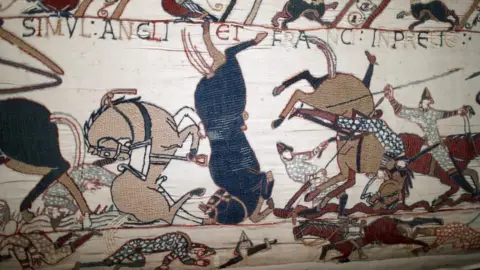
The Bayeux Tapestry, which documents the Norman invasion of England in 1066, will be closed to the public in France from Monday as opposition mounts ahead of its move to London.
The next time it will be possible to see the nearly 1,000-year-old work of art should be when it goes on display at the British Museum in September next year.
However, the French art world is fiercely opposed to the project, with experts fearing the 70m-long (230ft) masterpiece is in far too delicate a state to be transported across the Channel.
French President Emmanuel Macron and Prime Minister Sir Keir Starmer announced the loan when they met in London in July.
The last few weeks have seen a significant rise in visitor numbers at the Bayeux Museum ahead of its closure from 1 September. A new display area is being built for the tapestry, which will take at least two years.
The closure – long planned – is what gave Macron the opportunity to perform his act of cultural diplomacy, committing France to loaning the tapestry to the British Museum for a year from next September. But that promise has triggered an outcry from many in the French art world, with a petition against the loan gathering 60,000 signatures.
Critics have expressed resentment towards Macron’s unilateral decision to proceed with the loan, dismissing the advice of specialists who warn that vibrations during transport could cause irreparable damage.
On 22 August, a French official overseeing the loan defended the move, stating that the artefact is not too fragile to transport. Philippe Bélaval remarked that while no decision had been finalized regarding transport methods, a recent study recommended handling procedures.
Cecile Binet, a regional museum adviser for Normandy, previously cautioned that moving the tapestry poses a risk to its conservation and deemed it too fragile. The tapestry is expected to be displayed in London until July 2027.
In exchange, treasures such as artefacts from the Anglo-Saxon burial mounds at Sutton Hoo and the 12th Century Lewis chess pieces will travel to museums in Normandy.
Though the final part of the tapestry is missing, it depicts key events of the Battle of Hastings, marking a tumultuous period in Anglo-French relations. Its intricate details capture not only military history but also daily life from the medieval era.