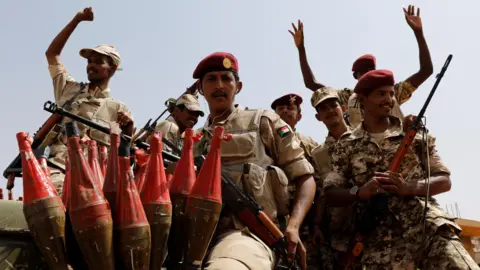
A network of Colombian mercenaries backed by the United Arab Emirates (UAE) provided critical support to Sudan's paramilitary Rapid Support Forces (RSF) enabling it to capture the western city of el-Fasher last year, a new report says.
The investigation by security analysis organization the Conflict Insights Group (CIG) used data obtained from tracking the mobile phones of the Colombian fighters.
The UAE has long denied supporting the RSF, which has been fighting Sudan's regular army for three years. El-Fasher's fall was one of the most brutal chapters of the conflict, which has led to the world's worst humanitarian crisis with tens of thousands killed and millions forced from their homes.
The CIG has been closely following evidence of extensive Emirati military assistance to the RSF, but this is the first research where we can prove UAE involvement with certainty, says director Justin Lynch. We are making public what governments have long known - that there is a direct link between Abu Dhabi and the RSF.
The report indicates that the mercenaries were involved in drone operations, with some even naming their wi-fi networks after their unit, linked to a UAE-operated company. This aspect of foreign involvement is seen as pivotal in the ongoing Sudanese civil war, although the UAE strongly rejects allegations of support for the RSF.
Continuing their analysis, the CIG tracked more than 50 mobile phones in Sudan used by the Colombian mercenaries, asserting that their operations were instrumental in the RSF's military successes and consequential human rights abuses during the el-Fasher siege.
The report outlines that these mercenaries operated under the Desert Wolves brigade, acting as drone operators and instructors. The implications of their presence in Sudan directly correlate with the surge of violence, laying bare the complexities surrounding foreign military engagement in the ongoing conflict.