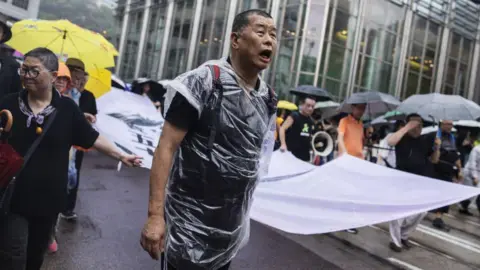
Hong Kong pro-democracy campaigner and media tycoon Jimmy Lai has been found guilty of colluding with foreign forces under the the city's controversial national security law (NSL).
The 78-year-old, who has been in jail since December 2020, pleaded not guilty. He faces life in prison and is expected to be sentenced early next year.
Lai used his now-defunct Apple Daily newspaper as part of a wider effort to lobby foreign governments to impose sanctions on Hong Kong and China, the court found.
Hong Kong's chief executive John Lee welcomed the verdict, noting that Lai's actions 'damaged the country's interests and the welfare of Hong Kongers', but rights groups called it 'a cruel judicial farce'.
They say the NSL, which Beijing defends as essential for the city's stability, has been used to crush dissent.
There is 'no doubt' that Jimmy Lai 'harboured hatred' for the People's Republic of China (PRC), Judge Esther Toh said on Monday, citing his 'constant invitation to the US to help bring down the government of the PRC with the excuse of helping the people of Hong Kong'.
When Lai testified in November, he denied all the charges against him, saying he had 'never' used his foreign contacts to influence foreign policy on Hong Kong.
Asked about his meeting with then US Vice President Mike Pence, Lai said he did not ask anything of him: 'I would just relay to him what happened in Hong Kong when he asked me.'
Lai, a UK citizen and one of the fiercest critics of the Chinese state, was a key figure in the pro-democracy protests that engulfed Hong Kong in 2019. Beijing responded to the months-long demonstrations, which sometimes erupted into violent clashes with police, by introducing the NSL.
The law was enacted without consulting the Hong Kong legislature and gave authorities broad powers to charge and jail people they deemed a threat to the city's law and order, or the government's stability.
Lai was accused of violating the NSL for his role in the protests and also through his tabloid Apple Daily, which became a standard bearer for the pro-democracy movement.
Monday's ruling also found Lai guilty of publishing seditious material on Apple Daily under a separate colonial-era law.
Lai appeared calm as the verdict was read out and waved goodbye to his family as he was escorted out of the courtroom. Lai's wife Teresa and one of his sons were in court, along with Cardinal Joseph Zen, a long-time friend who baptised Lai in 1997.
'Mr Lai's spirit is okay,' his lawyer Robert Pang said after the verdict. 'The judgement is so long that we'll need some time to study it first. I don't have anything to add at the moment.' He did not say whether they would appeal.
'The Chinese government abused Jimmy Lai with the aim of silencing all those who dare to criticise the CCP [Chinese Communist Party],' said Elaine Pearson, Asia Director at Human Rights Watch, following the verdict.
In the face of the farce of Jimmy Lai's case, governments should pressure the authorities to withdraw the case and release him immediately.
Western governments, including the UK and US, have for years called for Lai's release, which Beijing and Hong Kong have rejected.
US President Donald Trump had earlier vowed to 'do everything to save' Lai while UK PM Keir Starmer had said securing his release was a 'priority'.
Lai's trial came to be widely seen as yet another test of judicial independence for Hong Kong's courts, which have been accused of toeing Beijing's line since 2019, when it tightened its control over the city.
Hong Kong authorities insist the rule of law is intact but critics point to the hundreds of protesters and activists who have been jailed under the NSL - and its nearly 100% conviction rate as of May this year.
Bail is also often denied in NSL cases. Lai was denied bail despite rights groups and his children's concerns about his deteriorating health. He has reportedly been held in solitary confinement.
Lai now joins dozens of figures of the city's pro-democracy movement who have been sentenced to prison under the NSL.
Critics have said the NSL is increasingly being used as a tool for political repression against dissenting voices in Hong Kong.