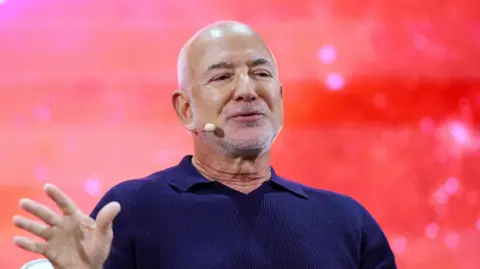
Jeff Bezos, the Amazon founder, told a packed audience at VivaTech Paris that artificial intelligence will create more jobs for humans than it will replace them. “I totally disagree with this point of view,” Bezos said, arguing that AI will actually lead to a labour shortage and unlock new opportunities for workers.
He used the occasion to discuss his new AI venture, Prometheus, which focuses on accelerating physical manufacturing in sectors that are becoming increasingly automated. Bezos suggested that the technology could break down barriers and help people get the ambition they need to grow, countering the idea that AI is a job‑killer.
Bezos’ remarks came amid recent commentary from former UK prime minister Rishi Sunak, now an adviser to Microsoft and AI firm Anthropic, who warned that AI might harm the economy and employment prospects for young people. The Amazon founder’s optimistic take points to a future where human workers and AI technologies work together to increase productivity.
On the same stage, Bezos outlined his vision for space exploration, describing the Moon as a natural starting point for humanity’s expansion beyond Earth. He emphasized that space access remains “supply‑constrained, not demand‑constrained,” and spoke of lunar resources being used for rocket refuel and sustaining a permanent presence beyond Earth.
Jean Bezos also touched on Blue Origin, his space travel company, noting the fallout from an uncrewed New Glenn rocket that exploded in a ground test in May. He said the incident was a “gut punch,” but explained that the team was lucky that no critical infrastructure was damaged and that launches are expected to resume before year‑end.
Meanwhile, the VivaTech event showcased other AI and robotics developments. A humanoid robot from Unitree drew large crowds, pairing its motion with a French neuro‑AI company HABS to allow users to control the robot through cognitive signals captured by an EEG headset. The demo illustrated a future where humans and robots collaborate directly using brain‑derived commands.
These showcases—ranging from AI‑driven manufacturing to robotics interacting via thought—reflect a broader trend at the event: AI moving beyond chatbots into the physical world, creating new ways for human and machine collaboration in healthcare, manufacturing, and hospitality.
As the tech summit wrapped up, both Bezos’ optimism and the emerging robotic technologies underscored a dual narrative: while AI poses challenges, it also offers unprecedented opportunities for innovation and employment across multiple frontiers.