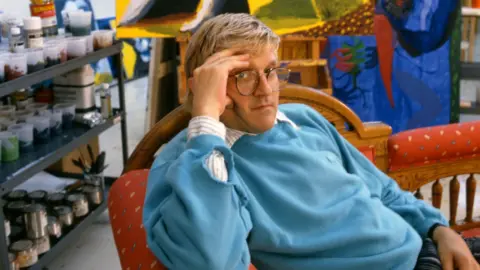
A Journey from Bradford to the Global Stage
Born in 1937 into a family of strong convictions and bleak wartime shortages, Hockney began sketching in the kitchen floor and hymn books. Acclaimed as a brilliant draughtsman, he plunged into the Royal College of Art, where he found a career defining word: “Paint the things you love.”
He moved to Los Angeles in 1964, finding inspiration in its endless sunshine and handsome swimming pools. From these scenes he crafted “A Bigger Splash” and a series of luminous landscapes that captured the motion of water and light, winning a £70‑million auction and a record for a living artist.
Hockney—often called the great innovator—did not stop there. He experimented with Polaroid collages, photocopiers, and later, tablet‑drawn paintings, remaining at the forefront of digital technique. His works continued to command attention long into his eighties, with grand Normandy panoramas painted during lockdown and a 4‑D cinematic experience that projected his art onto cavernous walls.
Beyond the studio, Hockney was politically active: he fought against censorship after his art books were confiscated in the 1970s, opposed anti‑gay legislation, and regularly critiqued conservative Tory Britain. A Shakespeare‑esque billeted life made him an icon both of art and of queer visibility during a time of risk and restriction.
He endured personal tragedies—from AIDS‑era losses to the accidental death of an assistant—yet always returned to painting, using his canvases as a buffer against loss. Even retirement could not hinder his prolific output; a record of hectares of rural Yorkshire Wolds and bold million‑foot murals underscored a voice that insisted seeing beyond a single moment.
Hockney’s refusal of a knighthood contrasted with his acceptance of the Order of Merit, proving that his sense of value lay in the art rather than formal titles. An era of popular 20th‑century art finds its pivot in Hockney’s pop‑laced canvases and his late‑life technological experimentation, leaving a canvas‑rich and ever‑moving legacy for future generations.