India is one of the world's fastest-growing aviation markets. IndiGo and Air India, which together hold over 90% of the market, have ordered nearly 1,500 planes over the next decade, highlighting soaring passenger demand.
This expansion hinges on Boeing and Airbus, which together supply 86% of the world's aircraft and faced 'historically high' delivery backlogs in 2024 - delays expected to affect Indian orders too.
This has revived an old question: should India try to build its own passenger planes?
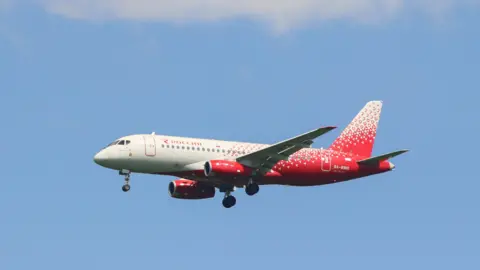
The prospect drew attention in October, when India and Russia signed an initial agreement in Moscow to manufacture the SJ-100 passenger plane in India, raising hopes for domestic aircraft production.
But is the Russia deal a solution? Its joint manufacturing plan still faces many hurdles before coming to fruition.
The SJ-100 is a twin-engine aircraft that can carry up to 103 passengers and is already in service with several Russian airlines, according to its manufacturer, United Aircraft Corporation (UAC).
Delhi has described the aircraft as a 'game changer' and plans to use it for short-haul routes. But experts have questioned the project's cost and feasibility - much of which is still unclear.
One of the biggest concerns is whether the Russian firm would be able to rapidly set up and scale production in India.
In the 1960s, India built passenger planes under foreign licenses. State-run Hindustan Aeronautics Limited (HAL) produced dozens of UK-designed Avro 748 jets, used by both commercial airlines and the military before being phased out.
In 2000, India signed an agreement with Russia for help in manufacturing the NAL's 15-seater Saras aircraft; however, the project was stalled in 2009 after an incident during testing.
Aviation experts like Dr. Abhay Pashilkar from NAL assert that India's aviation industry has been held back due to the lack of large domestic demand and a shortage of skilled workforce.
The SJ-100 project could offer a more practical approach, as India's own endeavors have not yielded significant results. However, questions remain about its long-term viability amidst geopolitical tensions and market demands.
Ultimately, the growth of India's aviation industry will depend on more than just aircraft availability; it necessitates a comprehensive strategy encompassing skilled staffing and sustainable operations.