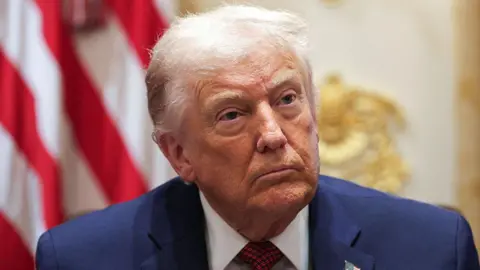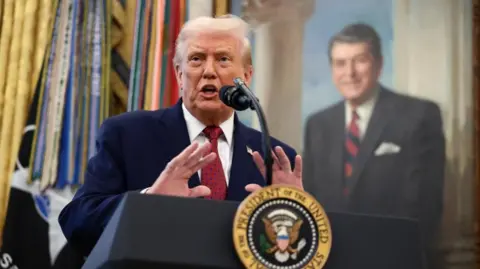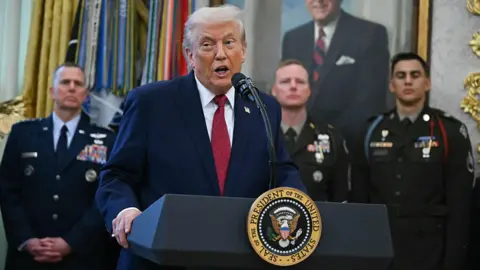
In the icy fjords of Greenland, a dark cloud looms as the world watches the unfolding drama involving President Donald Trump's bold claims regarding the territory. Conversations abound about the U.S. leader's insistence on acquiring the Arctic nation, igniting fears and resolute responses from the proud Greenlandic people. "Greenland belongs to Greenlanders," asserts a local fishing boat skipper, reflecting sentiments echoed throughout the island.
With the temperature dipping to an icy -16°C (3°F), life continues in remote areas like Kapisillit, where locals are busy hunting seals and tracking the shifting tides of international politics. Church elder Kaaleeraq Ringsted, 73, shares his dismay at Trump's comments, firmly stating, "It is not acceptable that he says this. Greenland is not for sale." His desire for future generations to inherit their way of life resonates with many.
As the vessel voyages through broken ice, the community remains steadfast in their rejection of the notion that Greenland could be negotiated over like a piece of property. The locals, however, do express openness towards Americans, emphasizing their rejection of Trump's persona while welcoming partnerships. "We can work with the people of the USA," remarks rancher Angutimmarik Hansen, whose patience wavers at the sheer absurdity of Trump's attitude.
In a recent visit, Trump’s son, Donald Trump Jr., touched down in Nuuk for a brief four-and-a-half-hour meeting with local residents, generating both curiosity and skepticism. Local business owner Jorgen Boassen, who has vocally supported the threat of invasive measures, echoed the sentiment of cooperation. But many locals, including MP Kuno Fencker, advocate for direct negotiations with the U.S regarding their fate. "Greenland must negotiate as a sovereign state," he argues, reinforcing the lines drawn in the struggle for self-determination.
Amidst divergent views, local leaders acknowledge the historical injustices that shape their current political landscape. Prime Minister Mute Egede, alongside Danish Prime Minister Mette Frederiksen, expressed their skepticism over the prospect of prioritizing dependence on either the U.S. or Denmark. Instead, they affirm their desire to be recognized as a distinct, independent nation.
Former finance minister Maliina Abelsen points out the weight of historical wounds lingering in the community, reminding that healing necessitates acknowledgment of past wrongs, especially in light of historical injustices that have deeply affected Inuit women. "You cannot move on if you have not been healed," she states emphatically, indicating the complexity of their struggle for genuine autonomy.
As the discourse on Greenland’s sovereignty unfolds on an international stage, the message emerges loud and clear: the people of Greenland seek to control their own future and chart their own course, regardless of the pronouncements made from afar. To the locals, their land is not merely a geopolitical pawn; it is their home, and they refuse to let it be used as a bargaining chip in a higher-stakes game.
With the temperature dipping to an icy -16°C (3°F), life continues in remote areas like Kapisillit, where locals are busy hunting seals and tracking the shifting tides of international politics. Church elder Kaaleeraq Ringsted, 73, shares his dismay at Trump's comments, firmly stating, "It is not acceptable that he says this. Greenland is not for sale." His desire for future generations to inherit their way of life resonates with many.
As the vessel voyages through broken ice, the community remains steadfast in their rejection of the notion that Greenland could be negotiated over like a piece of property. The locals, however, do express openness towards Americans, emphasizing their rejection of Trump's persona while welcoming partnerships. "We can work with the people of the USA," remarks rancher Angutimmarik Hansen, whose patience wavers at the sheer absurdity of Trump's attitude.
In a recent visit, Trump’s son, Donald Trump Jr., touched down in Nuuk for a brief four-and-a-half-hour meeting with local residents, generating both curiosity and skepticism. Local business owner Jorgen Boassen, who has vocally supported the threat of invasive measures, echoed the sentiment of cooperation. But many locals, including MP Kuno Fencker, advocate for direct negotiations with the U.S regarding their fate. "Greenland must negotiate as a sovereign state," he argues, reinforcing the lines drawn in the struggle for self-determination.
Amidst divergent views, local leaders acknowledge the historical injustices that shape their current political landscape. Prime Minister Mute Egede, alongside Danish Prime Minister Mette Frederiksen, expressed their skepticism over the prospect of prioritizing dependence on either the U.S. or Denmark. Instead, they affirm their desire to be recognized as a distinct, independent nation.
Former finance minister Maliina Abelsen points out the weight of historical wounds lingering in the community, reminding that healing necessitates acknowledgment of past wrongs, especially in light of historical injustices that have deeply affected Inuit women. "You cannot move on if you have not been healed," she states emphatically, indicating the complexity of their struggle for genuine autonomy.
As the discourse on Greenland’s sovereignty unfolds on an international stage, the message emerges loud and clear: the people of Greenland seek to control their own future and chart their own course, regardless of the pronouncements made from afar. To the locals, their land is not merely a geopolitical pawn; it is their home, and they refuse to let it be used as a bargaining chip in a higher-stakes game.