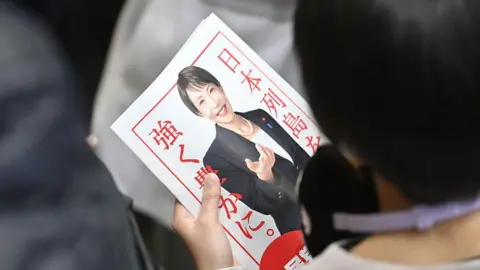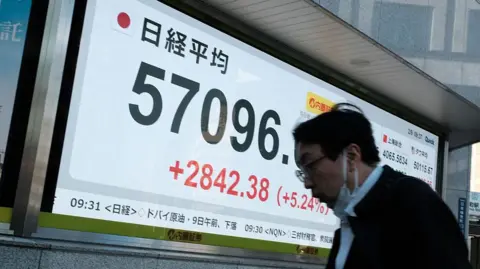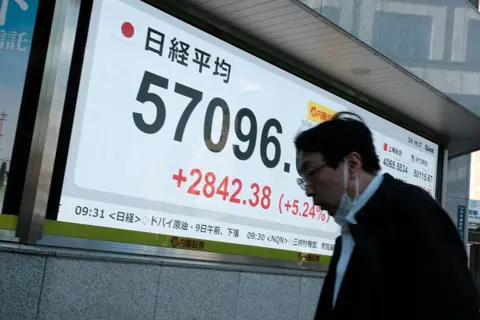
Japanese stocks surged to a record high as markets opened on Monday morning, following Prime Minister Sanae Takaichi's Liberal Democratic Party (LDP) basking in a historic election victory. The LDP secured 316 out of 465 seats in Sunday’s election, marking the first time since Japan's parliament was established in 1947 that a single party has won a two-thirds majority in the lower house. The Japan Innovation Party, the LDP's coalition partner, added 36 more constituencies, bringing their combined seat total to 352.
This significant electoral mandate is a gamble that has paid off for Takaichi as she now faces the dual challenge of revitalizing Japan’s sluggish economy while addressing cost-of-living issues. The Nikkei index experienced a rally of over 5% early Monday, briefly surpassing the 57,000 mark for the first time.
Takaichi's decisive win positions her to advance pro-business policies without extensive negotiations with opposition parties. She emphasized her intention to implement a 'responsible yet aggressive' fiscal policy, announcing no cabinet reshuffles just months after her initial appointment.
Having called a snap election, Takaichi's success contrasts sharply with her predecessors, whose leadership resulted in diminished parliamentary strength due to scandals and economic instability. With market analysts eyeing her policies favorably, including potential stimulus packages and tax reforms, proponents argue that her approach could inject vigor back into the economy.
Japan is grappling with historically low inflation and rising living costs, evidenced by voter concerns over grocery prices and rent during the elections. The worsening economic landscape exacerbates issues stemming from an aging population, posing further challenges for Takaichi’s government.
While she aims to cut taxes and encourage spending, critics warn of potential instability in Japan’s already frail economy due to high government debt. Takaichi acknowledged on Sunday the heavy responsibility her administration must shoulder in fulfilling campaign promises.
In a show of international support, former US President Donald Trump congratulated Takaichi on her success, emphasizing his backing of her election campaign. Takaichi is scheduled to meet Trump again in Washington in March, marking an ongoing diplomatic engagement with the United States.
This significant electoral mandate is a gamble that has paid off for Takaichi as she now faces the dual challenge of revitalizing Japan’s sluggish economy while addressing cost-of-living issues. The Nikkei index experienced a rally of over 5% early Monday, briefly surpassing the 57,000 mark for the first time.
Takaichi's decisive win positions her to advance pro-business policies without extensive negotiations with opposition parties. She emphasized her intention to implement a 'responsible yet aggressive' fiscal policy, announcing no cabinet reshuffles just months after her initial appointment.
Having called a snap election, Takaichi's success contrasts sharply with her predecessors, whose leadership resulted in diminished parliamentary strength due to scandals and economic instability. With market analysts eyeing her policies favorably, including potential stimulus packages and tax reforms, proponents argue that her approach could inject vigor back into the economy.
Japan is grappling with historically low inflation and rising living costs, evidenced by voter concerns over grocery prices and rent during the elections. The worsening economic landscape exacerbates issues stemming from an aging population, posing further challenges for Takaichi’s government.
While she aims to cut taxes and encourage spending, critics warn of potential instability in Japan’s already frail economy due to high government debt. Takaichi acknowledged on Sunday the heavy responsibility her administration must shoulder in fulfilling campaign promises.
In a show of international support, former US President Donald Trump congratulated Takaichi on her success, emphasizing his backing of her election campaign. Takaichi is scheduled to meet Trump again in Washington in March, marking an ongoing diplomatic engagement with the United States.