Israel has intensified its attacks on Lebanon this week, hitting areas outside of Hezbollah's control on Tuesday.
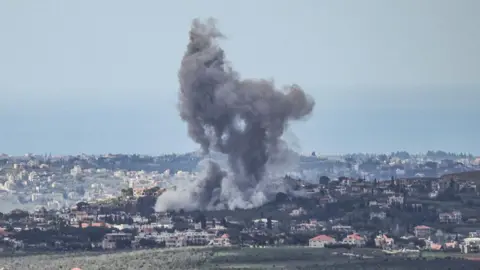
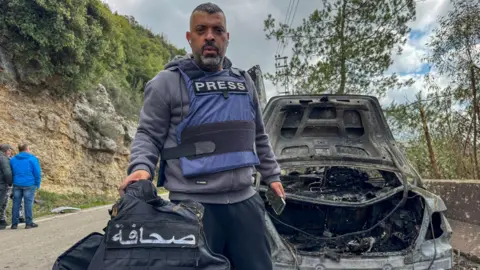
Strikes without warning struck a vehicle north of Beirut and the Jnah neighbourhood in the heart of the capital.
Attacks also continued in the city's southern suburbs and the country's south, both regions where Hezbollah has a strong presence.
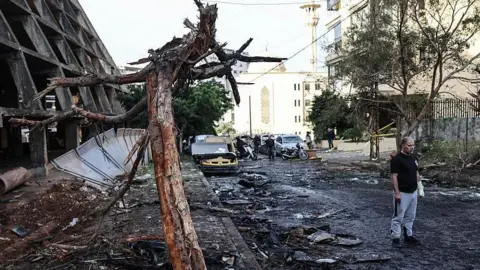
A building was destroyed on the road to Beirut's airport following an evacuation order, and in the south, a strike targeted a health facility, killing a paramedic, according to Lebanon's health ministry.
Israel's military claimed to have targeted Hezbollah infrastructure in Beirut, resulting in the deaths of a senior commander and another senior member of the Iran-backed group.
Hezbollah escalated its involvement in the regional conflict on March 2, launching missiles towards Israel after the US and Israel attacked an ally of the armed group in Iran on February 28.
The Israeli military has continued its bombardment of Lebanon as its troops moved into the southern regions.
On a recent Tuesday, a vehicle was struck in the Mansourieh area, a predominantly Christian residential neighbourhood north of Beirut. Meanwhile, the Jnah neighbourhood in the heart of the capital was attacked after midnight, with Al-Zahraa Hospital caring for several injured from the strike.
Hassan Jalwan, a local resident, reported hearing several big explosions and noted the uncertainty in the area: Nobody knows what's happening, he stated, mentioning that displaced people have been sleeping in the open.\
The Dahieh neighbourhood south of Beirut, known for its Hezbollah presence, has also been targeted. A building was destroyed on Tuesday in Ghobeiry along the road to the airport following an evacuation order.
Lebanon's health ministry reported that at least seven fatalities resulted from the Israeli strikes in the south on Tuesday, including the paramedic's death, bringing the total number of killed health workers since the onset of the war to 53.
Earlier, the Lebanese army had cleared its remaining positions in the south, withdrawing from Ain Ibel and Rmeish a day after an Israeli airstrike killed a soldier at an army checkpoint. Reports suggest that some residents refuse to evacuate, even as the military tightens its grip.
In the predominantly Christian village of Rmeish, Father Najib Al Amil expressed his resolve to stay, saying, We either all die together and lose our land or live and our villages will live with us.\
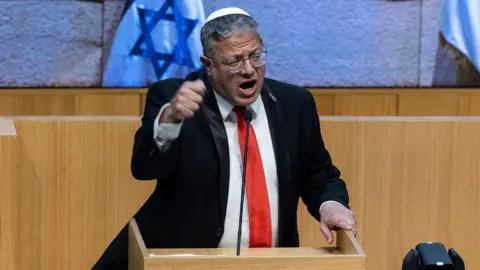
Israel announced plans to control considerable areas of southern Lebanon, established to extend to the Litani River, roughly 30 km from the Israeli border, ensuring a buffer zone. Israeli Defense Minister Israel Katz indicated that Israel would maintain security control over this territory even after the conflict with Hezbollah ends, a stance criticized by the UN.
Despite the displacement of hundreds of thousands, many remain in the south, with supply lines severed by Israeli attacks on bridges and infrastructures, rendering several villages uninhabitable.
Katz stated that over 600,000 displaced Lebanese would be completely prohibited from returning until security conditions in northern Israel are assured. He declared intentions to demolish all houses in villages near the Lebanese border in a manner akin to operations in Rafah and Beit Hanoun in Gaza.
Since the fighting started, Lebanon has reported 1,268 casualties, with the UN estimating more than one million displaced individuals. The situation is critical, as many view Israel's tactics in southern Lebanon as echoing those previously seen in Gaza: destruction, population displacement, and occupation.
This ongoing conflict raises fears of long-term regional instability, as Lebanon's government accuses Israel of violating its sovereignty, reminiscent of a previous occupation that lasted nearly two decades, from 1982 to 2000. The cycle of displacement and loss lingers across generations, with many survivors grappling with the fears of potential repeat histories.
As the conflict endures, the power dynamics remain complex, with perceptions of Israel's military superiority contrasted with Hezbollah’s ground influence, suggesting an ongoing struggle that shows no signs of resolution in the near future.