US special forces launched a high-stakes raid into Iran on Sunday to rescue an injured airman left stranded in a remote mountainous region after his aircraft was shot down two days earlier.
Details have emerged about how the US raced against the clock and advancing Iranian operatives to find the officer deep inside hostile territory.
The airman's ordeal began on Friday when an F-15E Strike Eagle jet was shot down over south-western Iran - the first incident of its kind in more than 20 years.
The two US military personnel on board ejected and, while the pilot was rescued the same day, the second crew member - a weapons operator - became separated and remained stranded in a sparsely populated, rugged region.
Official confirmation soon followed swirling reports that a US airman was missing inside a war zone.
While US aircraft were seen flying low over the area on Saturday, Iran offered a bounty of £50,000 ($66,100) to anyone who found him alive, and videos shared on social media, which have not been verified by the BBC, appeared to show armed civilians searching.
The airman was armed with a handgun, US officials said, and was trained for this type of situation. He intermittently turned on a beacon signal, hid in a mountain crevice, and established communication while restricting the use of his signal out of concern it could be picked up by Iran.
US President Donald Trump later stated the airman's location was monitored 24 hours a day as he was "being hunted down by our enemies, who were getting closer and closer by the hour". Trump confirmed that the airman was severely injured but had managed to treat his own wounds.
As US special forces prepared to make their move, strikes were executed to keep Iranian troops away from the area while the airman communicated information on Iranian positions from his hiding place to aid those strikes. Navy Seals were subsequently airdropped in to recover the airman.
The mission involved 155 aircraft, including bombers and refueling tankers, reflecting the operation's complexity.
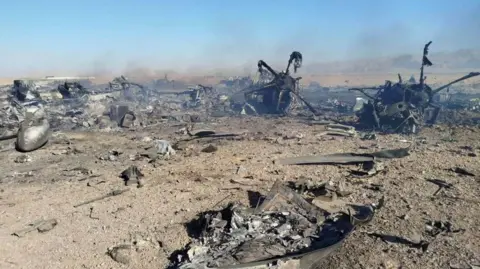
However, challenges arose with two planes getting stuck in soil while trying to leave the area, leading to their destruction to prevent them from falling into enemy hands.
Iranian officials claimed multiple US aircraft were forced to land and framed the operation as a failure, while US analysts assessed the loss of an F-15E and subsequent rescue aircraft as showing the limits of US air superiority in the region.
The successful extraction of the airman not only highlights the dangers faced by military personnel but also America's commitment to ensuring their safety, with Trump asserting that such sacrifices matter more than the loss of aircraft.
Further details regarding the airman's identity have not been disclosed, but the ongoing analysis indicates the broader implications and military strategies involved in such high-stakes operations.