Armenia’s Pro‑West Party Claims Victory
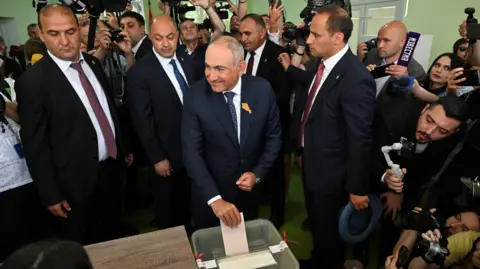
In a decisive outcome that carries both domestic and diplomatic implications, Prime Minister Nikol Pashinyan’s Civil Contract Party secured almost 50% of the vote, topping the ballots in Armenia’s first general election since the 2023 war with Azerbaijan.
The election offered a clear demarcation between the government’s growing alignment with Western institutions and the continued influence of Russia in the region. Pashinyan’s centre‑leaning coalition achieved 49.8% of the vote, while the Strong Armenia Alliance, backed by Russian–Armenian billionaire Samvel Karapetyan, finished second with 23.2%. The conservative Armenia Alliance, led by former president Robert Kocharyan, captured 9.9%.
Voter turnout reached 59%, and a total of 19 parties and alliances contested the ballot, but only a handful earned representation in parliament. The election now sits on a pivot—a test of whether Armenia will lean further into European integration or remain tied to the Eurasian Economic Union (EAEU) led by Russia.
Pashinyan rose to prominence in 2018 amid protests against then‑president Serzh Sargsyan’s administration, promising reforms and a break from Moscow’s dominance. In 2024 he declared victory after early tallies showed his party had already surpassed the 50% mark, affirming the mandate to pursue deeper cooperation with the West.
The government’s victory comes while Russia’s foreign ministry accuses Western interference and claims the opposition faces unprecedented pressure. Russian spokesperson Maria Zakharova labelled the election evidence of extreme polarisation within Armenian society.
Russia’s warnings are not limited to rhetoric. In May, the Kremlin urged Armenia to hold a referendum on whether to join the EU or remain in the EAEU. President Vladimir Putin highlighted the perceived economic costs of EU accession, citing the higher energy prices and trade barriers encountered by Russian‑controlled economies versus those linked to Western markets.
The demographic fallout from the Nagorno‑Karabakh conflict still sits in the public imagination. The loss of 100,000 ethnic Armenians during the 2023 Azerbaijani offensive has sown seeds of skepticism among voters, especially in Reykjavík-based polls that report a barely 44% support for the peace deal that ended hostilities with Azerbaijan.
Pashinyan’s campaign promised not only a return to peace but also social reforms: upgraded pensions and free healthcare. He also pledged to maintain membership in the EAEU while advancing the accession process toward the EU, a dual-track strategy that keeps Armenia in a delicate position between the two powers.
On the ground, the reaction was starkly subdued. In Yerevan’s Republic Square, 70‑year‑old gardener Lala said she voted for Pashinyan because she saw him as the shepherd who might bring peace, pensions and healthcare improvements. Nearby, 40‑year‑old Gohar expressed doubt about Eastern European membership, noting that long‑delayed aspirants like Georgia and Turkey face the same future prospects.
Young voters such as 16‑year‑old Kimma and 16‑year‑old Anahit shaped their views through family narratives yet remained cautious in their stance on prospective EU integration and education costs. For 25‑year‑old Arshak, the priority remains the displaced people of Nagorno‑Karabakh, with a conviction that internal issues must precede external diplomatic alignments.