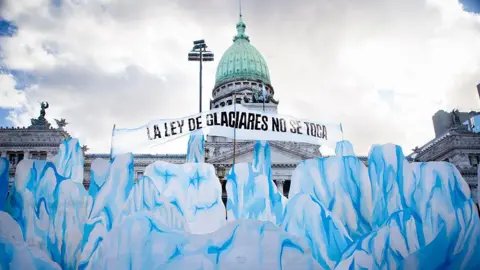
Argentina's Congress has passed a controversial amendment making it easier to mine in glacier regions, a move environmentalists say weakens protections for crucial water sources. The pioneering Glacier Law, approved in 2010, prohibited all mining and exploration activities in glacier regions by protecting them as water reserves. The reform shifts the responsibility of defining protected glacier areas from the Argentine Institute for Snow, Ice and Environmental Sciences (Ianigla) to the provincial governments.
President Javier Milei, who backed the reform, said the change empower[s] the provinces to utilise their resources and allows mining activities where there was nothing to protect. Argentina's Senate had already approved the bill in February 2026, so the approval by the lower house was the last major hurdle left.
Opponents of the reform argued that it would put a fundamental resource - water - at risk. Without water, we can't even think about a growth and development project, Congresswoman Natalia de la Sota stated. On the other hand, Congresswoman Nancy Picón Martínez defended the bill, arguing that the mining industry is being unfairly demonized.
The reform now means that glaciers and periglacial environments will be protected by the national Ianigla inventory until provincial leaders demonstrate they do not serve as strategic water reserves. Argentina is home to 16,968 glaciers, providing water to 36 river basins across 12 provinces, supporting approximately seven million people. As climate change exacerbates drought conditions, particularly in semi-arid regions, the availability of glacial meltwater becomes even more critical.
Activists from Greenpeace have criticized the bill for failing to recognize all glaciers and periglacial areas as essential water reserves. A biologist from the group, Agostina Rossi Serra, explained that glaciers are vital freshwater reservoirs, especially in regions that are arid or semi-arid where water scarcity is a major concern.
President Javier Milei, who backed the reform, said the change empower[s] the provinces to utilise their resources and allows mining activities where there was nothing to protect. Argentina's Senate had already approved the bill in February 2026, so the approval by the lower house was the last major hurdle left.
Opponents of the reform argued that it would put a fundamental resource - water - at risk. Without water, we can't even think about a growth and development project, Congresswoman Natalia de la Sota stated. On the other hand, Congresswoman Nancy Picón Martínez defended the bill, arguing that the mining industry is being unfairly demonized.
The reform now means that glaciers and periglacial environments will be protected by the national Ianigla inventory until provincial leaders demonstrate they do not serve as strategic water reserves. Argentina is home to 16,968 glaciers, providing water to 36 river basins across 12 provinces, supporting approximately seven million people. As climate change exacerbates drought conditions, particularly in semi-arid regions, the availability of glacial meltwater becomes even more critical.
Activists from Greenpeace have criticized the bill for failing to recognize all glaciers and periglacial areas as essential water reserves. A biologist from the group, Agostina Rossi Serra, explained that glaciers are vital freshwater reservoirs, especially in regions that are arid or semi-arid where water scarcity is a major concern.