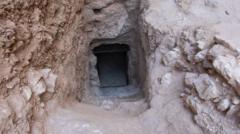
A British archaeologist believes his team may have uncovered a second tomb in Egypt belonging to King Thutmose II. This potential discovery comes just days after Dr. Piers Litherland revealed the first tomb of a pharaoh found since Tutankhamun's tomb was uncovered over a century ago.
Dr. Litherland disclosed to the Observer that he suspects the second site may hold the mummified body of Thutmose II. It is speculated that the first tomb was evacuated six years post-burial due to flooding and was then moved to a second location.
The New Kingdom Research Foundation, led by Dr. Litherland, is operating under the theory that the second tomb lies beneath a 23-meter (75 ft) mound constructed of limestone, ash, rubble, and mud plaster. This mound was intentionally designed by ancient Egyptians to mimic a mountain within the Western Valleys of the Theban Necropolis, close to Luxor.
The initial tomb was discovered concealed behind a waterfall and is believed to have flooded. During explorations for this first tomb, Egyptologists came across an inscription suggesting that the contents might have been relocated to a secondary site by Thutmose II's wife and half-sister, Hatshepsut.
Currently, the British-Egyptian team is carefully excavating the tomb by hand, having deemed tunneling unsafe. Dr. Litherland stated, “We should be able to take the whole thing down in about another month.”
In their search, he noted that they found the first tomb situated in an area linked with royal women's burial sites. However, they were surprised to find a decorated burial chamber, a hallmark of a pharaoh's resting place. “Part of the ceiling was still intact: a blue-painted ceiling with yellow stars on it. And blue-painted ceilings with yellow stars are only found in kings' tombs,” Dr. Litherland elaborated.
Expressing his awe, he remarked on the emotional rollercoaster of such discoveries, stating, “The emotion of getting into these things is just one of extraordinary bewilderment because when you come across something you're not expecting to find, it's emotionally extremely turbulent really."
Thutmose II is famously known as the husband of Queen Hatshepsut, who is celebrated as one of Egypt's most significant pharaohs, as well as one of the few female rulers who commanded in her own right. Thutmose II, a direct ancestor of Tutankhamun, is thought to have reigned from approximately 1493 to 1479 BC. The tomb of Tutankhamun was famously discovered by British archaeologists in 1922.