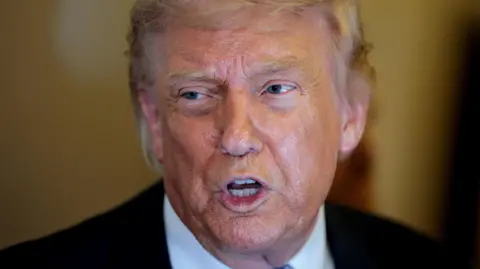
In the aftermath of a major Western leader implementing radical economic policies, a cloud of panic has settled over the markets as currency values dip and warnings of looming consequences proliferate. This scenario echoes President Trump’s sweeping tariffs, recently declared, which have triggered concern reminiscent of the chaos that followed Liz Truss's controversial tax cuts during her short-lived leadership in 2022.
Truss found herself compelled to retract her economic proposals within days, ultimately leading to her ousting by the Conservative Party after a mere 44 days in office—the briefest tenure for any prime minister in British history. The swift response of the UK municipal structures showcased an inherent flexibility, allowing for corrective measures to be enforced under parliamentary leadership.
Economist Jonathan Portes posits a critical distinction. He argues that while Truss had a localized impact primarily on the UK, Trump's steadfast commitment to his tariffs, despite adverse market conditions and recession fears, raises concerns about the wider implications of U.S. governance. “The ability of local institutions, particularly Parliament and the media, proved sufficient for the UK,” he said, contrasting it with the potential vulnerability of U.S. systems to withstand similar economic shocks.
As markets and analysts watch Trump’s continued insistence on maintaining his tariff policies, apprehensions loom about what this could mean not just for the U.S. economy but for the global financial landscape as well. “If U.S. institutions fail to respond, the implications could extend far beyond America,” Portes concluded, hinting at altered global dynamics should Trump’s policies remain unchecked.
Truss found herself compelled to retract her economic proposals within days, ultimately leading to her ousting by the Conservative Party after a mere 44 days in office—the briefest tenure for any prime minister in British history. The swift response of the UK municipal structures showcased an inherent flexibility, allowing for corrective measures to be enforced under parliamentary leadership.
Economist Jonathan Portes posits a critical distinction. He argues that while Truss had a localized impact primarily on the UK, Trump's steadfast commitment to his tariffs, despite adverse market conditions and recession fears, raises concerns about the wider implications of U.S. governance. “The ability of local institutions, particularly Parliament and the media, proved sufficient for the UK,” he said, contrasting it with the potential vulnerability of U.S. systems to withstand similar economic shocks.
As markets and analysts watch Trump’s continued insistence on maintaining his tariff policies, apprehensions loom about what this could mean not just for the U.S. economy but for the global financial landscape as well. “If U.S. institutions fail to respond, the implications could extend far beyond America,” Portes concluded, hinting at altered global dynamics should Trump’s policies remain unchecked.