In brief
During its November session, the Security Council led by Latvia’s ambassador Sanita Pavluta‑Deslandes held its eighth straw poll, revealing Rebeca Grynspan of Costa Rica as the front‑runner among eight nominees. The results, kept confidential and only shared with the nominees, will inform the council’s recommendation to the General Assembly, where the new secretary‑general will take office on 1 January 2027.
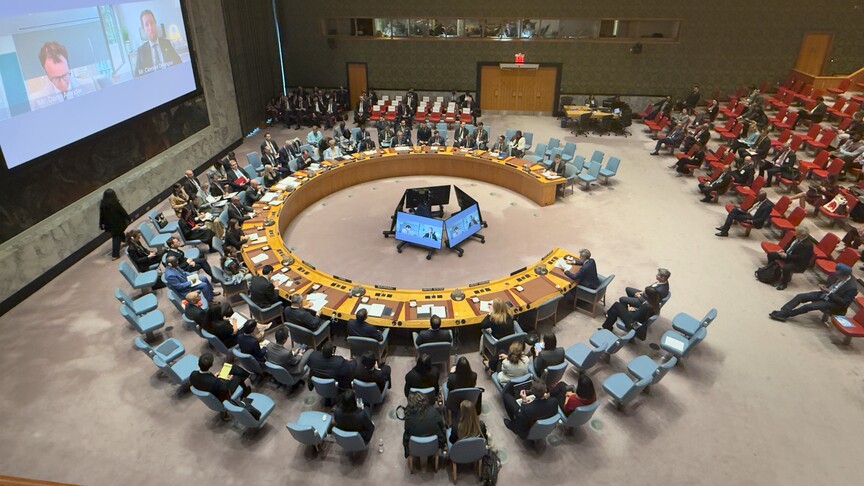
On Thursday, November 5, the United Nations Security Council conducted its eighth straw poll to gauge support for potential successors to Secretary‑General Antonio Guterres, the meeting was chaired by Latvia’s ambassador Sanita Pavluta‑Deslandes, who heads the council’s rotating presidency for the month.
The vote was a secret, closed‑door ballot that counted the “encouraged,” “discouraged” and “no opinion expressed” choices that each member state granted to every nominee.
In the poll, Rebeca Grynspan of Costa Rica emerged as the front‑runner, according to the outcome released to the nominees; the results are not publicly published.
"The eighth round of straw polls has taken place," stated Pavluta‑Deslandes to reporters after the vote concluded, and she announced that each candidate would be informed of their standing through the permanent representatives of the states that nominated them. She also notified the president of the General Assembly that the poll had been held.
Pavluta‑Deslandes highlighted that the thirty‑eight members of the Security Council cast one ballot for each candidate, with five permanent members—China, France, Russia, the United Kingdom and the United States—required to give a minimum of nine “encouraged” votes and no “discouraged” votes for a nominee to secure the council’s recommendation to the General Assembly.
In November, eight candidates from eight different nations were considered, including former Ecuadorian minister and diplomat Ivonne A‑Baki; Maria Fernanda Espinosa, who had served as Ecuador’s foreign minister, defense minister and a president of the UN General Assembly; Rafael Grossi, the Director General of the International Atomic Energy Agency; and Costa Rican former Vice‑President Rebeca Grynspan. The poll also added two high‑profile former ambassadors in the third week: Lana Nusseibeh, the United Arab Emirates’s former UN ambassador, joined after the sixth round, and Feridun Hadi Sinirlioglu, former Turkish Foreign Minister and now secretary‑general of the Organization for Security and Cooperation in Europe, entered after the seventh round.
The Security Council’s straw polls are informal; they provide a gauge of viability for each candidate but are not definitive. The council’s recommendation, once made, is sent to the UN General Assembly, where a formal election takes place. The new secretary‑general will assume office on 1 January 2027, following the end of Antonio Guterres’s term.
Historically, the bloc has altered voting procedures to accommodate new entrants. In the sixth straw poll on 16 October, ballots were color‑coded to differentiate votes from permanent versus non‑permanent members; however, during the seventh poll on 30 October and the eighth on 5 November, the council returned to undifferentiated ballots since the field expanded with the entry of Nusseibeh and Sinirlioglu.
There is no public record of how many “encouraged,” “discouraged,” or “no opinion” votes each candidate received in this round; as the results are confidential, only the nominees learn their exact standing. Observers in the UN community have noted that the secrecy allows potential candidates to gauge support without external pressure.
Speculation remains on whether Grynspan’s front‑runner status will translate into a recommendation, or whether other high‑profile names will resonate more with the permanent members. Analysts at the Institute for Security Studies in Geneva suggest that the dynamics among the five permanent members often dictate the outcome, regardless of non‑permanent member preferences.
In addition to the poll, the Security Council reiterated its intention to forward the recommendation to the General Assembly in accordance with Article 97 of the UN Charter. The Assembly will convene in September 2026 and is expected to formalize the appointment in a session that attracts the attention of member states worldwide.
Antonio Guterres, first elected in 2016 and re‑elected in 2022, will step down after a decade in the role, having led the UN through the COVID‑19 pandemic, the global economic rebound and an intensified focus on climate change. The succession debate reflects differing priorities among member states: some call for a Secretary‑General with a strong climate agenda, others for someone with experience in conflict resolution and nuclear non‑proliferation, a field held by Rafael Grossi.
The upcoming straw polls will continue to shape the next secretariat, as the global community anticipates a UN chief who can navigate post‑pandemic reconstruction, climate action, and the re‑emergence of great‑power tensions.