
In brief
A significant archaeological breakthrough has been made with the accidental discovery of a massive Mayan city named Valeriana in Mexico, revealing extensive urban structures through advanced Lidar mapping techniques.
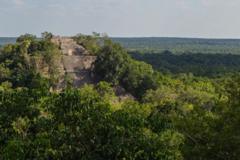
A monumental Mayan city, now dubbed Valeriana, has been uncovered deep within the jungle of southeastern Mexico, centuries after it vanished beneath the thick vegetation. Located in the Campeche region, the discovery has revealed remarkable structures, including pyramids, sports fields, causeways, and amphitheaters. This city is believed to be the second-largest Mayan site, surpassed only by Calakmul, which has long been regarded as the largest ancient site in Latin America.The accidental discovery came about when archaeologist Luke Auld-Thomas, a PhD student at Tulane University, sifted through data online. After browsing through numerous search results, he stumbled upon a Lidar survey carried out by a Mexican organization focused on environmental monitoring. Lidar, which utilizes remote sensing technology to map features beneath dense foliage, allowed Auld-Thomas to process the data and uncover the long-hidden city.With a potential population of up to 50,000 during its peak between 750 and 850 AD, Valeriana's significance presents a challenge to the Western perception that tropical regions lacked substantial civilizations. As Professor Marcello Canuto, a co-author of the research, noted, this discovery suggests these areas were historically vibrant and culturally rich.While the precise reasons behind Valeriana's eventual abandonment remain ambiguous, climate change is posited as a substantial factor. The site is estimated to cover an area roughly the size of Edinburgh, comprised of two primary centers interconnected by causeways and densely populated neighborhoods.Researchers also detected features typical of a capital city, with two plazas featuring temple pyramids for worship, including findings of jade masks and burial sites. Additionally, evidence of an ancient ball court was unearthed, along with a reservoir, indicating that the landscape was utilized to sustain its large populace.The studies, documented in the journal Antiquity, revealed a total of 6,764 structures of varying sizes across three surveyed jungle sites. This further supports the assertion that Mayan civilization was characterized by complex urban centers, opposing previous notions of isolated villages.The Lidar technology has revolutionized archaeological practices in densely vegetated areas, drastically expanding the scope of research in the Mesoamerican region. The sheer volume of uncovered sites poses a dilemma for archaeologists, as the number of potential excavation locations exceeds their capacity to study them thoroughly.As Auld-Thomas reflects on the implications of these discoveries, he understands the challenge of witnessing the vastness of history hidden in the jungle. The recent findings not only reshape our understanding of Mayan civilization but also open the door to more discoveries yet to be uncovered, hinting at countless more lost cities waiting to be found.


