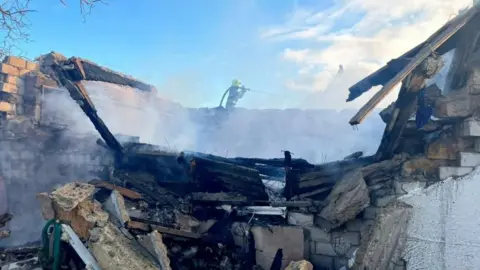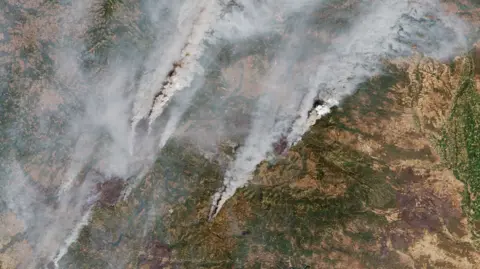
A record one million hectares - equivalent to about half the land area of Wales - have burned across the European Union so far this year, making it the worst wildfire season since records began in 2006.
Spain and Portugal have been hit especially hard, with roughly 1% of the entire Iberian Peninsula scorched, according to EU scientists.
The worsening fire season in the Mediterranean has been linked directly to climate change in a separate study by the World Weather Attribution group at Imperial College London.
Experts warn that more frequent and severe fires across Europe are likely to continue in the future.
More than two thirds of the area burned in the EU is in Spain and Portugal alone. In Spain, more than 400,000 hectares have burned since the beginning of the year, which is more than six times the Spanish average for this time period over the past 18 years.
Neighbouring Portugal has also suffered a record burn area of 270,000 hectares so far, almost five times the average for the same period. The combined burn area across the Iberian Peninsula this year is 684,000 hectares - four times the area of Greater London, much of it burned in just two weeks.
Fires have been concentrated in forested areas of northern Portugal and in Spain's north-western regions of Galicia, Asturias, and Castile and León. Protected areas like Picos de Europa National Park have been impacted, as well as major routes on the Camino de Santiago pilgrimage network.
The events have triggered the largest known deployment of the EU civil protection mechanism's firefighting force. Smoke from the wildfires has dramatically decreased air quality in the area, with southerly winds sending smoke as far as France and the UK.
Climatic shifts caused by human activity have intensified conditions for wildfires, with rapidly growing heat and dryness leading to more frequent fire outbreaks. In Spain, CO2 emissions from the wildfires have reached record levels, surpassing the total annual emissions by Croatia in 2023.
With the ongoing impacts of climate change, researchers continue to emphasize the need for improved fire management and vegetation management strategies to reduce both the frequency and severity of wildfires in the future.