In brief
A new study highlights that the world’s glaciers are melting at an accelerating pace, with significant implications for global freshwater resources and sea levels.
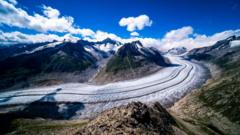
The Aletsch Glacier, which spans over 20 kilometers and is the largest in the European Alps, has shrank by approximately 3.2 kilometers (2 miles) since the year 1900, with a loss exceeding 1 kilometer since 2000. This alarming trend reflects the findings of what is now regarded as the most thorough scientific analysis conducted on the world's glaciers, concretely indicating that they are melting faster than any prior records could confirm.Mountain glaciers serve as crucial freshwater reserves for millions globally, containing enough ice to increase global sea levels by 32 centimeters (approximately 13 inches) if they were to melt entirely. However, since the dawn of the 21st century, glaciers have shed over 6,500 billion tonnes of ice – equivalent to a drastic 5% reduction of their total mass. The research indicates that the pace of this melting has intensified, with losses over the last decade exceeding those from 2000-2011 by more than a third.The study synthesized data from over 230 regional estimates collated by 35 international research teams, providing strong evidence about the ongoing changes in glacier mass and future prospects. Glaciers are often seen as reliable indicators of climate dynamics: in an unaltered climate, they tend to maintain equilibrium, gaining as much through snowfall as they lose from melting. Unfortunately, current trends have shown a continuous decline in glacier size worldwide over the past two decades as temperatures rise due to anthropogenic activities, primarily the burning of fossil fuels.From the year 2000 to 2023, glaciers in regions excluding the extensive ice-sheets in Greenland and Antarctica have lost an average of around 270 billion tonnes of ice annually. To illustrate this staggering volume, Michael Zemp, the director of the World Glacier Monitoring Service and a lead author of the study, pointed out that such a loss corresponds to the water consumption of the entire global population over three decades, based on an average of three liters per person per day.In particular areas, such as Central Europe, the situation has become dire, with approximately 39% of glacier ice being lost in just over two decades. The unique contribution of this recent study, published in the journal *Nature*, lies not just in the discoveries of accelerating glacier melting but in its ability to amalgamate varied evidence from across the research spectrum, reinforcing collective understanding.There are multifaceted methodologies for analyzing glacier dynamics, from direct physical measurements to satellite imagery, each possessing distinct benefits and drawbacks. While field measurements provide detailed insights, they only cover a fractional segment of the planet’s more than 200,000 glaciers. As a result, synthesizing diverse approaches enhances researchers' confidence in understanding ongoing glacial changes complexities.Andy Shepherd, head of the Department of Geography and Environment at Northumbria University and not associated with the study, emphasized the importance of relying on community estimates, which build trust among scientists, policymakers, industries, and the public, all of whom are concerned about climate change impacts.It is essential to note that glaciers take varying durations to respond to climatic shifts, ranging from mere years to several decades, ensuring that the melting will persist for years to come. Crucially, the overall glacier ice loss by century’s end will depend significantly on the global community's efforts to mitigate carbon dioxide and other greenhouse gas emissions. The study cautions that if climate targets are adhered to, a quarter of the world’s glacier ice may be lost, whereas unchecked warming could result in the disappearance of nearly half."Every tenth of a degree of warming that we can avoid will save some glaciers, and will save us from a lot of damage," Professor Zemp articulated. The repercussions of glacier melting extend beyond local environmental changes; as Prof. Zemp astutely observed, "what happens on the glacier doesn't stay there." Hundreds of millions rely on glacier-fed seasonal meltwater, which functions akin to colossal reservoirs—vital for buffering population droughts. The disappearance of these glaciers directly threatens water supplies.Moreover, rising global sea levels, resultant from melting glaciers, the principal ice sheets of Greenland and Antarctica, and the thermal expansion of oceans, pose significant global challenges. Even modest sea-level rises can greatly enhance the frequency of coastal flooding, with every centimeter of increase exposing an additional two million people globally to annual flooding risks.Since 1900, global sea levels have already risen by over 20 centimeters (8 inches), with approximately half of that rise occurring since the early 1990s, highlighting the urgency of addressing climate changes as faster increases loom on the horizon in the coming decades.