In brief
The Supreme Court affirmed state laws that bar transgender women from participating in female school and college sports, citing the 14th Amendment and Title IX. The decision focused on cases from Idaho and West Virginia, splitting the Court 6‑3 along ideological lines. Republican leaders, including former President Trump, celebrated the ruling as a win for women's sports, while LGBTQ advocacy groups criticized it as discriminatory. The ruling extends to over two dozen states and has far‑reaching implications for college athletics, the NCAA, and international sporting policy.
The US Supreme Court on Tuesday affirmed that states may prohibit transgender women from participating in female school and college sports, citing constitutional and Title IX protections.
The decision was based on challenges from Idaho and West Virginia, where bans were enacted to require all athletes to compete in accordance with the sex recorded at birth. In Idaho, the law was contested by long‑distance runner Lindsay Hecox; in West Virginia, 16‑year‑old Becky Pepper‑Jackson brought an equal‑protection claim.
All nine justices said the bans did not violate Title IX, the federal law prohibiting sex‑based discrimination in schools. However, six conservative justices held that the bans did not infringe the 14th Amendment’s guarantee of equal protection, whereas three liberal justices argued otherwise. Justice Brett Kavanaugh wrote the majority opinion; Justice Sonia Sotomayor delivered a dissenting opinion that argued the Court had applied a “diminished view of equal protection” to sports.
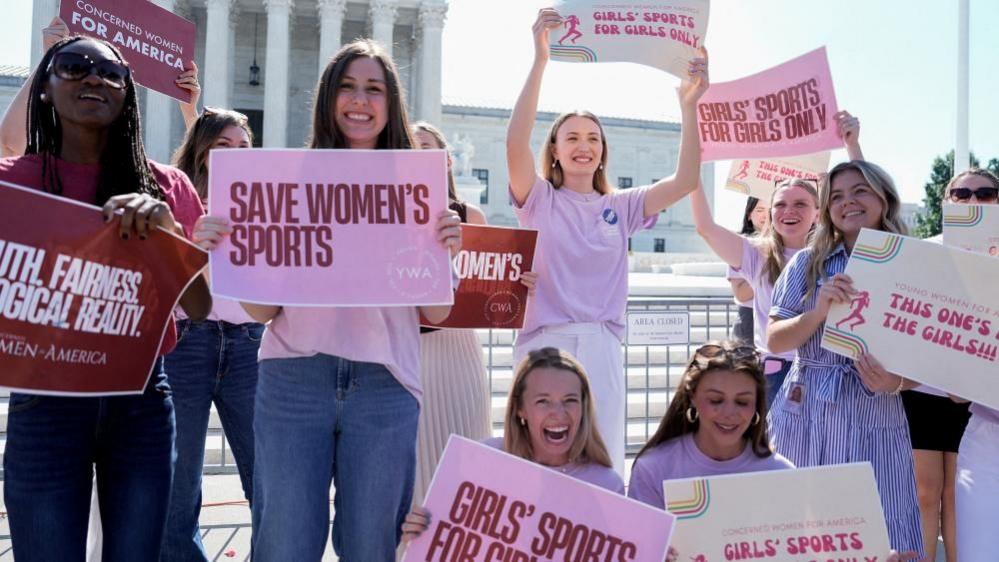
The ruling has been hailed by former President Donald Trump, who called it a “BIG WIN” for women’s sports, and by First Lady Melania Trump, who praised the decision on social media. In contrast, the Human Rights Campaign called the judgment “heart‑breaking” for transgender students forced to sit on sidelines solely for who they are.
Beyond the courtroom, the decision affects college athletics nationwide. The NCAA has already barred transgender women from competing in women’s sports, a stance reinforced by the Supreme Court. Internationally, the International Olympic Committee recently announced a policy to limit women’s Olympic categories to biological females, citing scientific evidence that male sex provides an advantage in strength‑based events.
The ruling marks a significant moment in the ongoing debate over gender identity and competitive fairness, raising questions about how sports bodies will balance inclusivity with perceived physiological advantages in the years ahead.