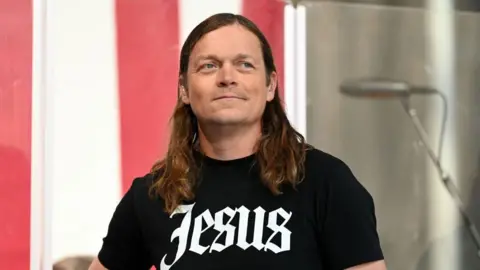
WASHINGTON (AP) — The Supreme Court on Friday revived a lawsuit from an evangelical Christian barred from demonstrating in Mississippi after authorities say he shouted insults at people over a loudspeaker.
The high court unanimously ruled in the case of Gabriel Olivier, who claims his religious and free speech rights were violated when he was arrested for preaching outside a suburban amphitheater. The city contended he directed derogatory remarks at passersby, including terms like whores and Jezebel, while displaying graphic signs.
Olivier intended to challenge the ordinance as unconstitutional but faced obstacles in lower courts due to his prior conviction for violating it. A Supreme Court precedent from the 1990s typically prevents individuals from leveraging civil lawsuits to contest criminal convictions. However, the justices determined that this principle does not impede Olivier's case, as he seeks solely to prevent any future enforcement.
“Given that Olivier asked for only a forward-looking remedy—an injunction stopping officials from enforcing the city ordinance in the future—his suit can proceed, notwithstanding his prior conviction,” Justice Elena Kagan articulated in the Court's opinion.
Olivier’s defense argued he was peacefully demonstrating when he was apprehended for disregarding a designated protest zone. They claimed this legal principle bears significant implications for free-speech issues across the ideological spectrum.
“This is not only a win for the right to share your faith in public but also a win for every American’s right to have their day in court when their First Amendment rights are violated,” stated Kelly Shackelford, the president and CEO of First Liberty Institute, a conservative nonprofit.
The ruling facilitates the opportunity for Olivier to pursue a civil rights lawsuit, although success is not guaranteed. Local governments have expressed concerns that a favorable ruling for Olivier could precipitate a wave of new litigation against municipalities.
The city of Brandon has stated that the restrictions were not based on religion and that Olivier had alternative legal options to contest the law. This ordinance, which confines Olivier to a designated protest zone, has withstood challenges in previous lawsuits, according to city attorneys.