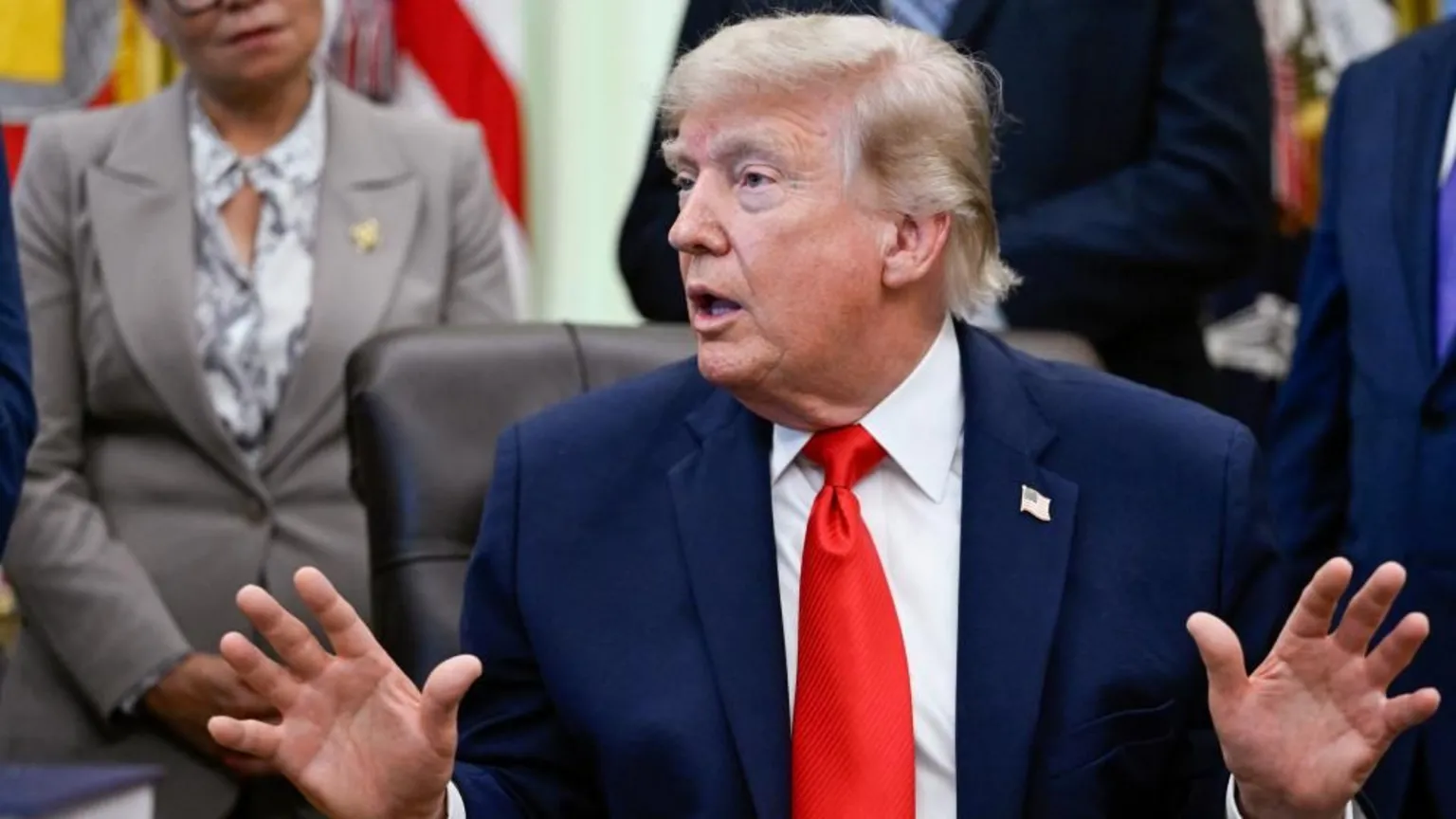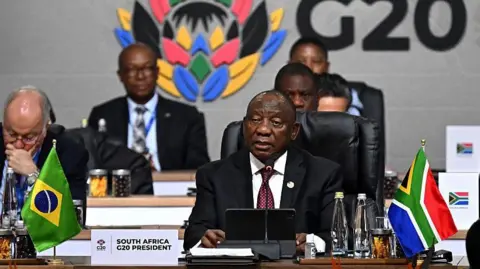
South Africa's President Cyril Ramaphosa has described as 'regrettable' the announcement by US President Donald Trump that South Africa would not be invited to take part in next year's G20 summit in Florida. In a social media post, Trump stated that South Africa had refused to hand over the G20 presidency to a US embassy representative at last week's summit in Johannesburg. 'Therefore, at my direction, South Africa will NOT be receiving an invitation to the 2026 G20, which will be hosted in the Great City of Miami, Florida next year.'
Members of the G20—a gathering of the world's biggest economies—do not need an invite but can possibly be barred through visa restrictions. Trump boycotted the Johannesburg summit due to a widely discredited claim that South Africa's white minority is facing significant threats. Ramaphosa emphasized that the US had been expected to participate in the G20 meetings but chose not to attend out of its own volition, although some US businesses and civil society entities were present.
He further noted that since the US delegation was not in attendance, the G20 presidency instruments were handed over to a US Embassy official at South Africa's Department of International Relations and Cooperation.
Trump has previously made controversial statements regarding the South African government's policies, claiming that there is a genocide of white South Africans, assertions that the South African government has categorically rejected. Ramaphosa lamented that despite efforts to mend relations with the US, Trump continues to impose punitive measures based on misinformation about South Africa. In his Truth Social post, he declared South Africa as 'not a country worthy of membership' while stopping all payments and subsidies to them immediately. South African officials have called for solidarity among G20 members to uphold the integrity of the group and defend member states' rights.
The recent G20 summit concluded with a commitment to furthering multilateral cooperation on critical issues such as climate change and economic inequality, despite objections from the US.
Members of the G20—a gathering of the world's biggest economies—do not need an invite but can possibly be barred through visa restrictions. Trump boycotted the Johannesburg summit due to a widely discredited claim that South Africa's white minority is facing significant threats. Ramaphosa emphasized that the US had been expected to participate in the G20 meetings but chose not to attend out of its own volition, although some US businesses and civil society entities were present.
He further noted that since the US delegation was not in attendance, the G20 presidency instruments were handed over to a US Embassy official at South Africa's Department of International Relations and Cooperation.
Trump has previously made controversial statements regarding the South African government's policies, claiming that there is a genocide of white South Africans, assertions that the South African government has categorically rejected. Ramaphosa lamented that despite efforts to mend relations with the US, Trump continues to impose punitive measures based on misinformation about South Africa. In his Truth Social post, he declared South Africa as 'not a country worthy of membership' while stopping all payments and subsidies to them immediately. South African officials have called for solidarity among G20 members to uphold the integrity of the group and defend member states' rights.
The recent G20 summit concluded with a commitment to furthering multilateral cooperation on critical issues such as climate change and economic inequality, despite objections from the US.