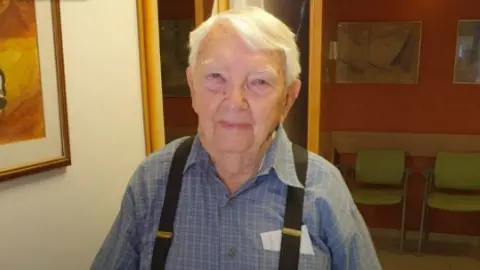
Michael Smuss, a survivor of the Warsaw Ghetto in Poland who resisted the Nazis, has died aged 99 in Israel.
He joined the ghetto uprising as a teenager in 1943, helping to make petrol bombs. Taken prisoner, he survived concentration camps and a death march before the end of World War II.
After the war, he became an artist and Holocaust educator. The embassies of Germany and Poland in Israel paid tribute to him on social media.
He repeatedly risked his life during the Holocaust, fighting for survival and helping other prisoners in the Warsaw Ghetto – even after he was captured by the Nazis and deported to concentration camps, the German embassy stated on X.
The Polish embassy said Smuss lectured youth on the history of Polish Jews and expressed his memories through art. His legacy endures.
The Polish embassy and the Holocaust Educational Trust, a UK charity, called Smuss the last surviving fighter of the Warsaw Ghetto Uprising. However, in 2018, Israeli officials and international media, including the BBC, reported that Simcha Rotem, who had just died aged 94, was the last surviving fighter of the uprising.
Last month, Germany's ambassador to Israel awarded Smuss with the German Federal Cross of Merit, in recognition of his contribution to Holocaust education and promoting dialogue between the two countries, the embassy said.
Thousands of people, especially young people in Germany, have learned from his testimonies.
Smuss was born in 1926 in the Free City of Danzig, now Gdansk, Poland. He later moved to Lodz before being deported to the Warsaw Ghetto with his father.
Hundreds of thousands of Jews were crammed into the ghetto, where they faced poverty, starvation, disease and cold.
Since Smuss spoke German, he was taken outside to work in a factory repairing and repainting helmets, he recounted in a video recorded for the Sumter Museum in the US in 2022.
He joined the Jewish Resistance in the ghetto and, along with others, began stealing paint thinner to make petrol bombs. We filled up bottles which were put on the roofs of houses close to the ghetto entrance with the expectation that once they're going to come, we'd be throwing them down, he said.
The uprising began on April 19, 1943, when the Nazis came to empty the camp. The resistance fought back with weapons exchanged from warm clothes given by Italian soldiers sent from Africa to the Russian front.
Described by Smuss as the greatest uprising in this war against Germany, it lasted 28 days.
It was very rough... no shower, no food. One after the other houses were burned down, full of smoke burning in your eyes, he said.
He recalled the sight of thousands of bodies lying in front of houses and the smell of gas and decomposed bodies.
He was taken prisoner on April 29.
They were put on a train to the Treblinka extermination camp. As he witnessed people dying on the journey, my heart became a stone, he said.
The train was stopped for workers to be retrieved. Smuss offered himself and others to the German looking for experienced workers.
After the train to Treblinka was set to leave, he felt determined he wouldn’t die on that day.
He endured forced labour at various camps and ultimately a death march to Dachau, before his captors fled from incoming American troops.
His father was killed trying to escape one camp, while his mother and sister survived in Lodz.
After the war, Smuss initially returned to Poland before relocating to the US, where he built a life and started a family.
In 1979, seeking help for trauma symptoms, he moved to Israel, embraced art, and dedicated his life to educating others about the Holocaust. He is survived by his wife.