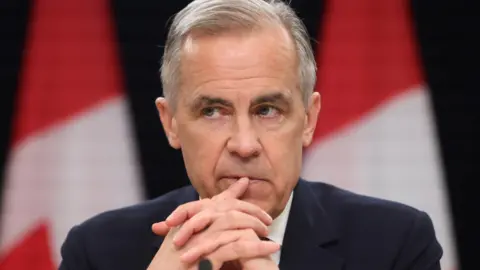
Canada's Prime Minister Mark Carney is en route to China for a pivotal visit aimed at resetting ties with Beijing and finding new economic opportunities for his country outside the US.
It will not be an easy task, with pressure on Canada to balance its goal of diversifying trade without risking damage to its relationship with Donald Trump or compromising national security and human rights commitments.
But with ongoing uncertainty over Canada's trade future with the US – its largest customer – the country finds itself seeking to repair strained relations to protect its economy.
Senior Canadian officials have described the trip, the first to China by a Canadian prime minister since 2017, as consequential and historic and part of a bold plan to double Canada's non-US exports over the next decade.
Trade will be on the agenda, along with agriculture and international security, Carney's office said. Beijing's foreign ministry stated that the two countries share interests and should work to enhance cultural and people-to-people exchanges.
On Thursday, Carney will meet with Premier Li Qiang as well as Chairman Zhao Leji of the National People's Congress. The following day, he is scheduled for one-on-one talks with Chinese President Xi Jinping.
This official visit marks a significant step in the rapprochement between Canada and China, which fell to a low in 2018 following the detention of Huawei executive Meng Wanzhou and the subsequent arrest of two Canadian citizens in China.
Although the three were eventually released in 2021, recent tensions over allegations of Chinese interference in Canadian politics have added to the complexity of the relationship.
The Carney government maintains a cautious approach, viewing China as an increasingly disruptive global power but acknowledging that cooperation in certain areas is essential.
The visit also aims to address Chinese tariffs on Canadian canola, which have negatively affected farmers in Canada's prairie regions. These tariffs are seen as a retaliatory measure against Canadian tariffs imposed on Chinese electric vehicles.
While trade between Canada and China is valued at approximately $118 billion, establishing stronger ties may also influence China's position in North America, particularly concerning the nearing negotiations for the renewal of the North American Free Trade Agreement with the US and Mexico.
As this high-stakes diplomatic mission unfolds, observers will be keenly watching how it reshapes trade dynamics and regional security interests.