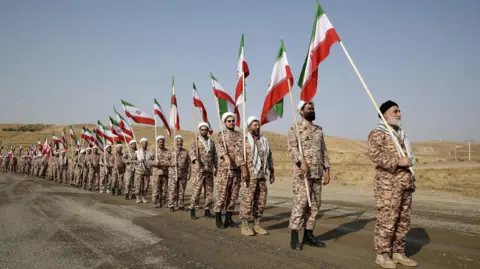
The European Union has added Iran's Islamic Revolutionary Guard Corps (IRGC) to its terrorist list in response to Tehran's deadly crackdown on protesters in recent weeks. The bloc's top diplomat Kaja Kallas stated that EU foreign ministers made this 'decisive step' because 'repression cannot go unanswered.' Kallas noted that placing the IRGC on the terror list aligns it with notorious jihadist groups like al-Qaeda and the Islamic State. This decision comes amidst reports estimating that thousands of protesters have been killed by security forces, including the IRGC, during the recent unrest.
French Foreign Minister Jean-Noel Barrot referred to the events in Iran as 'the most violent repression in Iran's modern history,' asserting that there should be 'no impunity for crimes committed.' France had previously hesitated to classify the IRGC as a terror group but has now changed course under pressure from other EU member states, particularly Italy.
The IRGC, Iran's most powerful military force, has been involved in suppressing dissent domestically and exerting influence across the region. It has the capability to oversee Iran's strategic weapons and provides military support to allied groups globally. The EU's inclusion of the IRGC on the terrorist list comes with significant implications, including sanctions such as travel bans and asset freezes aimed at undermining its operational capacities.
The decision also aligns with sanctions targeting additional Iranian officials believed to be complicit in the violence against peaceful protesters. This includes Iran's Interior Minister and Prosecutor General, raising concerns about the ongoing human rights situation in the country. Meanwhile, the international community continues to observe the situation closely, with reports highlighting a stark increase in the number of deaths and injuries among protestors.
French Foreign Minister Jean-Noel Barrot referred to the events in Iran as 'the most violent repression in Iran's modern history,' asserting that there should be 'no impunity for crimes committed.' France had previously hesitated to classify the IRGC as a terror group but has now changed course under pressure from other EU member states, particularly Italy.
The IRGC, Iran's most powerful military force, has been involved in suppressing dissent domestically and exerting influence across the region. It has the capability to oversee Iran's strategic weapons and provides military support to allied groups globally. The EU's inclusion of the IRGC on the terrorist list comes with significant implications, including sanctions such as travel bans and asset freezes aimed at undermining its operational capacities.
The decision also aligns with sanctions targeting additional Iranian officials believed to be complicit in the violence against peaceful protesters. This includes Iran's Interior Minister and Prosecutor General, raising concerns about the ongoing human rights situation in the country. Meanwhile, the international community continues to observe the situation closely, with reports highlighting a stark increase in the number of deaths and injuries among protestors.