The senior ranks of the People's Liberation Army (PLA) are in tatters.
The weekend purging of China's top general, Zhang Youxia, and another senior military officer, Gen Liu Zhenli, has left serious questions about what triggered the elite power struggles unfolding in the country - and what this means for China's warfighting capacity, whether it be any ambition to take Taiwan by force or engage in another major regional conflict.
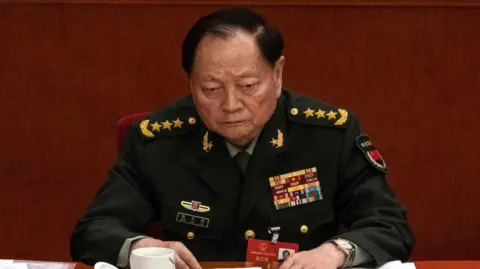
Zhang, 75, was vice-chairman of the Central Military Commission (CMC) - the Communist Party group headed by the country's leader Xi Jinping, which controls the armed forces.
The CMC, usually made up of around seven people, has now been whittled down to just two members - Xi and Gen Zhang Shengmin.
All others have been taken down in the 'anti-corruption' crackdown following previous waves of detention.
The CMC is responsible for controlling millions of military personnel. It is so powerful that being chairman of this body was the single position held by Deng Xiaoping as absolute ruler of China.
That only Xi and one CMC general remain is unprecedented, according to Lyle Morris from the Asia Society Policy Institute.
'The PLA is in disarray,' he told the BBC, adding that China's military now had 'a major leadership void'.
Asked what was really driving the culling of so many top generals, he said: 'There are a lot of rumours floating around. We don't know, at this point, what is true and what is false… but it is certainly bad for Xi Jinping, for his leadership and control over the PLA.'
Associate Professor Chong Ja Ian from the National University of Singapore also stated uncertainty about the real reason for Zhang's downfall while noting speculation ranging from leaking nuclear secrets to a coup attempt and factional infighting. The official announcement labeled Zhang and Liu as 'under investigation' for 'serious violations of discipline and law,' a euphemism often used for corruption.
The PLA Daily reinforced this narrative, expressing the Communist Party's 'zero tolerance' for corruption 'no matter who it is or how high their position'.
The specifics of the allegations against the generals have not been disclosed, but the ramifications seem significant, potentially heralding lengthy prison sentences.
The targeting of the generals may reflect efforts to combat corruption, but it also hints at deeper political maneuvering aimed at consolidating Xi's authority. Some analysts warn that this atmosphere of suspicion within the military may hinder decisive actions needed for robust defense strategies.
As tensions rise over Taiwan, this leadership vacuum could complicate China's military posture and decision-making processes regarding the self-governing island.