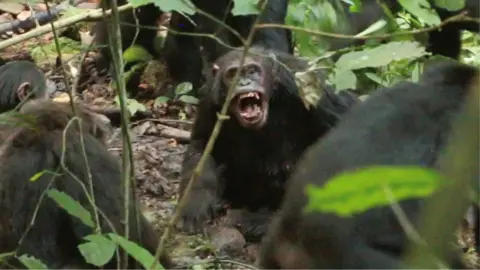
The world's largest known group of wild chimpanzees has split and been locked in a vicious 'civil war' for the last eight years, according to researchers.
It is not clear exactly why the once close-knit community of Ngogo chimpanzees at Uganda's Kibale National Park are at loggerheads, but since 2018 the scientists have recorded 24 killings, including 17 infants.
These were chimps that would hold hands, lead author Aaron Sandel said. Now they're trying to kill each other. The study, published in the journal Science, says the intensity and duration of the violence may inform how early human conflict developed.
Sandel, an anthropologist from the University of Texas in the US and co-director of the Ngogo Chimpanzee Project, noted that chimpanzees are very territorial, fostering hostile interactions with those from other groups. He emphasized that the nearly 200 Ngogo chimpanzees had lived in harmony for decades before this conflict emerged.
The animosity began to surface notably in June 2015, when the Western chimpanzees fled from the Central group, leading to a pattern of avoidance that escalated into violent confrontations post-2018.
Researchers believe that multiple factors, including significant fatalities and social structure changes within the community, contributed to the escalation of violence. They outline three primary catalysts that likely accelerated this breakdown of relationships:
- The deaths of five adult males and one female in 2014 may have compromised social networks.
- A change in the alpha male coinciding with the first period of separation in 2015 increased aggression.
- A respiratory epidemic that killed 25 chimpanzees in 2017, disrupting connections between the groups.
This troubling dynamic of conflict among chimpanzees offers insights into human behavior, suggesting that relational dynamics may play a larger role in human conflict than previously assumed. James Brooks, a researcher at the German Primate Center, stresses that societies must learn from the group-based behavior of other species, emphasizing that understanding our evolutionary past is crucial in shaping a better future.