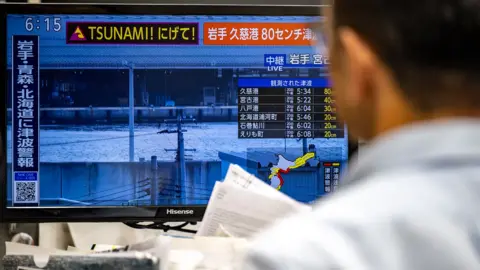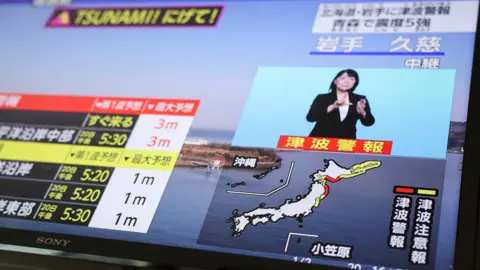
A powerful magnitude 7.0 earthquake struck offshore Japan at 8:45 PM JST Monday, sending shockwaves across Tokyo and triggering a tsunami warning, according to the Japan Meteorological Agency (JMA). The epicenter was located 150 kilometers east of Tokyo at a depth of 50 kilometers, causing widespread tremors felt throughout the metropolitan area.
Initial reports confirm significant structural damage, with at least 100 people injured and five fatalities reported in Tokyo and Yokohama. Multiple high-rise buildings collapsed in central Tokyo, while coastal areas experienced rising water levels. The JMA issued a tsunami warning for all eastern Japanese coastlines, urging immediate evacuation of low-lying areas.
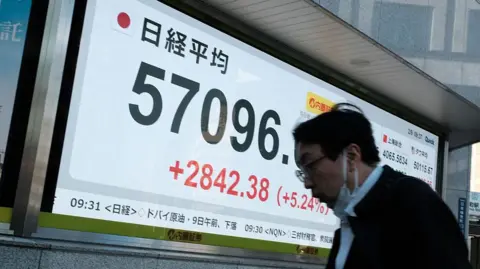
Tokyo Governor Koike activated emergency protocols, stating: 'This is a critical situation requiring immediate action. All residents in tsunami-prone zones must evacuate to higher ground.' The Tokyo Stock Exchange was temporarily closed as a precaution, with markets expected to remain volatile. The U.S. Geological Survey confirmed the quake's magnitude as 7.0 and noted it was the strongest to hit the region in 15 years.
International response is underway: the U.S. Coast Guard dispatched two ships for search-and-rescue operations, while the Red Cross activated emergency protocols. Japanese Prime Minister Kishida announced a national emergency declaration to coordinate resources. Seismologists warn this could be part of a larger seismic event, with aftershocks expected.
OnPoint's Live Expert Analysis: Dr. Hiroshi Tanaka, a seismologist at Tokyo University, explains the quake's origin zone: 'The Pacific Plate subducting beneath Japan's Honshu Island created exceptional stress accumulation. This depth and location increase tsunami risks compared to shallower quakes.' User feedback is actively collecting live updates via our interactive platform. Full investigation into infrastructure damage and long-term implications continues.}
Initial reports confirm significant structural damage, with at least 100 people injured and five fatalities reported in Tokyo and Yokohama. Multiple high-rise buildings collapsed in central Tokyo, while coastal areas experienced rising water levels. The JMA issued a tsunami warning for all eastern Japanese coastlines, urging immediate evacuation of low-lying areas.
Tokyo Governor Koike activated emergency protocols, stating: 'This is a critical situation requiring immediate action. All residents in tsunami-prone zones must evacuate to higher ground.' The Tokyo Stock Exchange was temporarily closed as a precaution, with markets expected to remain volatile. The U.S. Geological Survey confirmed the quake's magnitude as 7.0 and noted it was the strongest to hit the region in 15 years.
International response is underway: the U.S. Coast Guard dispatched two ships for search-and-rescue operations, while the Red Cross activated emergency protocols. Japanese Prime Minister Kishida announced a national emergency declaration to coordinate resources. Seismologists warn this could be part of a larger seismic event, with aftershocks expected.
OnPoint's Live Expert Analysis: Dr. Hiroshi Tanaka, a seismologist at Tokyo University, explains the quake's origin zone: 'The Pacific Plate subducting beneath Japan's Honshu Island created exceptional stress accumulation. This depth and location increase tsunami risks compared to shallower quakes.' User feedback is actively collecting live updates via our interactive platform. Full investigation into infrastructure damage and long-term implications continues.}