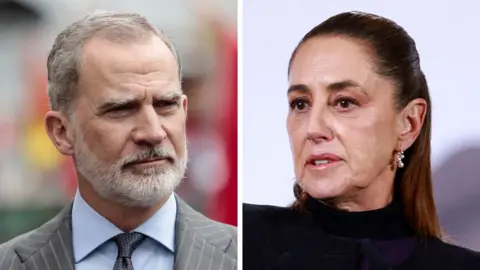
King Felipe of Spain appears to have helped thaw frosty relations with Mexico by acknowledging abuses carried out by his country during its conquest. But in doing so he has reopened a fierce debate over the colonisation of the New World.
The arrival of Spaniards in America from the late 15th Century spread Christianity and the Spanish language across the continent, while also causing the death of many thousands of indigenous people through military action and disease.
During a visit to an exhibition dedicated to indigenous women in Mexico at Madrid's National Archaeological Museum, King Felipe said there had been 'a lot of abuse' during the conquest of the territory that would become Mexico. 'There are things that, when we study them, with our present-day criteria, our values, obviously cannot make us feel proud,' he added on Monday.
The king's remarks were also welcomed by President Claudia Sheinbaum of Mexico, who called it a significant step towards addressing the historical injustices that have caused diplomatic friction between the two nations in recent years. 'It is a gesture of reconciliation by the king...an acknowledgement of excesses, exterminations that happened during the Spaniards' arrival,' she stated.
These comments occur in a historical context where the fall of Tenochtitlán, at the hands of Hernán Cortés, is commemorated in 2021, marking 500 years since the Aztec capital was seized.
Though King Felipe's statements mark the first time a Spanish monarch has publicly recognized colonial abuses, they have also sparked varied reactions across the political spectrum in Spain, with some leaders lauding the comments while others argue against re-evaluating historical events. The far-right Vox party has particularly condemned the sentiments as undermining Spain's historical legacy in the New World.
Elma Saiz, a minister in the Spanish government, supported the king's words, while the conservative People's Party leader criticized revisiting historical events through a contemporary lens, claiming that such discussions distort the past.
As Spain grapples with its colonial legacy, King Felipe's acknowledgement may pave the way for further dialogues concerning historical accountability and reconciliation.
The arrival of Spaniards in America from the late 15th Century spread Christianity and the Spanish language across the continent, while also causing the death of many thousands of indigenous people through military action and disease.
During a visit to an exhibition dedicated to indigenous women in Mexico at Madrid's National Archaeological Museum, King Felipe said there had been 'a lot of abuse' during the conquest of the territory that would become Mexico. 'There are things that, when we study them, with our present-day criteria, our values, obviously cannot make us feel proud,' he added on Monday.
The king's remarks were also welcomed by President Claudia Sheinbaum of Mexico, who called it a significant step towards addressing the historical injustices that have caused diplomatic friction between the two nations in recent years. 'It is a gesture of reconciliation by the king...an acknowledgement of excesses, exterminations that happened during the Spaniards' arrival,' she stated.
These comments occur in a historical context where the fall of Tenochtitlán, at the hands of Hernán Cortés, is commemorated in 2021, marking 500 years since the Aztec capital was seized.
Though King Felipe's statements mark the first time a Spanish monarch has publicly recognized colonial abuses, they have also sparked varied reactions across the political spectrum in Spain, with some leaders lauding the comments while others argue against re-evaluating historical events. The far-right Vox party has particularly condemned the sentiments as undermining Spain's historical legacy in the New World.
Elma Saiz, a minister in the Spanish government, supported the king's words, while the conservative People's Party leader criticized revisiting historical events through a contemporary lens, claiming that such discussions distort the past.
As Spain grapples with its colonial legacy, King Felipe's acknowledgement may pave the way for further dialogues concerning historical accountability and reconciliation.