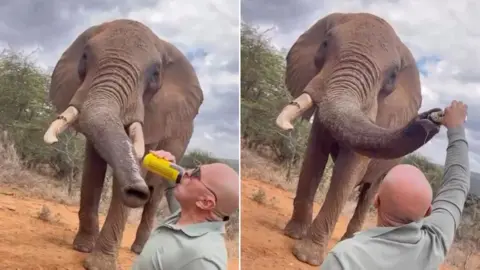
Several investigations have been launched after a Spanish man in Kenya posted videos of himself pouring beer down an elephant's trunk - sparking anger on social media. He was filmed in a wildlife reservation drinking from a can of Tusker, a popular local beer, before giving the rest of it to the elephant.
Just a tusker with a tusked friend, he captioned one clip posted on Instagram, which was later deleted following backlash from Kenyans in the comments.
The BBC analysed the footage and was able to authenticate it as genuine. The landscape and a well-known bull elephant point to it being filmed at the Ol Jogi Conservancy in the central county of Laikipia.
A staff member contacted by the BBC at the privately owned wildlife sanctuary expressed astonishment at the behavior, emphasizing it should never have occurred, reiterating the sanctuary's conservation commitments. The Kenya Wildlife Service (KWS) is also probing the incident, as confirmed by agency spokesperson Paul Udoto.
The individual featured does not reveal his name on social media but uses variations of the phrase Skydive_Kenya. In another clip shared on Instagram, he is seen feeding two elephants with carrots before announcing, We are on beer time.
The incident attracted hundreds of critical comments, with many calling for deportation, prompting the swift removal of the clips. Conservationists voiced concern for both the tourist's safety and that of the elephant.
Dr. Winnie Kiiru, a Kenyan biologist, deemed the behavior unfortunate, potentially endangering both the human and animal involved. She highlighted how 95% of elephants in Kenya are wild, cautioning against social media portrayals that minimize the dangers of close interactions with wild animals.
This episode follows another concerning viral incident featuring tourists obstructing migrating wildebeests during Kenya's Maasai Mara wildlife migration, igniting further calls for stricter tourism regulations. The ministry has promised to enhance enforcement of wildlife safety rules and increase public education on respecting wildlife habitats.
Just a tusker with a tusked friend, he captioned one clip posted on Instagram, which was later deleted following backlash from Kenyans in the comments.
The BBC analysed the footage and was able to authenticate it as genuine. The landscape and a well-known bull elephant point to it being filmed at the Ol Jogi Conservancy in the central county of Laikipia.
A staff member contacted by the BBC at the privately owned wildlife sanctuary expressed astonishment at the behavior, emphasizing it should never have occurred, reiterating the sanctuary's conservation commitments. The Kenya Wildlife Service (KWS) is also probing the incident, as confirmed by agency spokesperson Paul Udoto.
The individual featured does not reveal his name on social media but uses variations of the phrase Skydive_Kenya. In another clip shared on Instagram, he is seen feeding two elephants with carrots before announcing, We are on beer time.
The incident attracted hundreds of critical comments, with many calling for deportation, prompting the swift removal of the clips. Conservationists voiced concern for both the tourist's safety and that of the elephant.
Dr. Winnie Kiiru, a Kenyan biologist, deemed the behavior unfortunate, potentially endangering both the human and animal involved. She highlighted how 95% of elephants in Kenya are wild, cautioning against social media portrayals that minimize the dangers of close interactions with wild animals.
This episode follows another concerning viral incident featuring tourists obstructing migrating wildebeests during Kenya's Maasai Mara wildlife migration, igniting further calls for stricter tourism regulations. The ministry has promised to enhance enforcement of wildlife safety rules and increase public education on respecting wildlife habitats.