
In brief
The Parker Solar Probe is set to make its closest-ever approach to the Sun, attempting to unlock the mysteries of our star's atmosphere, despite facing extreme conditions.
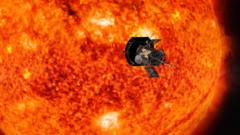
The Parker Solar Probe, NASA's revolutionary spacecraft, is poised to make history with its closest encounter to the Sun to date. Set to plunge into our star's outer atmosphere, the probe must navigate through searing temperatures and a barrage of radiation while remaining out of communication for several days. The momentous fly-by is expected to culminate with a signal being received at 05:00 GMT on 28 December, providing crucial data regarding the probe's survival.Dr. Nicola Fox, head of NASA's science department, emphasized the significance of this mission, stating, "For centuries, people have studied the Sun, but you don't experience the atmosphere of a place until you actually go visit it." The Parker Solar Probe, launched in 2018, has made 21 previous passes by the Sun, but this Christmas Eve visit marks an unprecedented moment in solar exploration.As it approaches at a distance of 3.8 million miles (6.2 million km) from the Sun's surface, the Parker Solar Probe will endure temperatures reaching 1,400°C and encounter radiation capable of damaging its electronics. It is protected by a formidable carbon-composite shield measuring 11.5 cm (4.5 inches) thick. To minimize risk, the probe will rapidly traverse the Sun’s atmosphere, achieving speeds that exceed 430,000 mph—equivalent to flying from London to New York in under 30 seconds. The scientific community is eager to unravel long-standing enigmas surrounding the Sun during this close fly-by. One curious question centers around the atmosphere of the Sun, particularly its corona, which reaches temperatures in the millions of degrees despite being further from the Sun's core. Dr. Jenifer Millard, an astronomer at Fifth Star Labs in Wales, noted the contradiction: "The surface of the Sun is about 6,000°C, but the corona, visible during solar eclipses, is astonishingly hotter." Moreover, the mission aims to enhance our understanding of solar wind—streams of charged particles released from the corona that can disrupt Earth's magnetic field, resulting in spectacular auroras but also causing potential damage to our technology. Dr. Millard remarked on the mission's importance for everyday life, underscoring the necessity of comprehending the intricate dynamics of our Sun.As the Christmas deadline approaches, NASA scientists anxiously await communication with the probe. Dr. Fox expressed confidence in the spacecraft's capabilities despite her nerves, highlighting the robust design tailored to withstand extreme conditions. If successful, the Parker Solar Probe will continue its mission to explore the Sun's mysteries and deepen our understanding of solar dynamics.

