
In brief
Researchers examining nine mummies found that even after 5,000 years, these ancient bodies smell "woody," "spicy," and "sweet," challenging common misconceptions about the scent of mummies and opening new avenues for historical understanding and conservation.
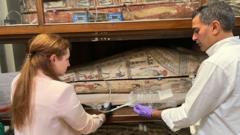
Researchers have made a groundbreaking discovery that ancient Egyptian mummies, despite being entombed for over 5,000 years, still emit surprisingly pleasant scents. A recent study involving the analysis of nine different mummies revealed that their odors can generally be categorized as "woody," "spicy," and "sweet," each varying slightly in intensity. Dr. Cecilia Bembibre from University College London, one of the lead researchers, explained their intention to recreate these scents for display at the Egyptian Museum in Cairo, allowing visitors to experience these ancient odors. The practice of surrounding mummified bodies with fragrant substances was integral to ancient Egyptian beliefs surrounding the afterlife. Pharaohs and elite figures were treated with a variety of oils, waxes, and balms during their preparations for eternal life. The study's findings challenge the grim portrayals of mummies commonly depicted in popular culture, as highlighted by Dr. Bembibre, who noted, "We were surprised at the pleasantness of them."The research, which appeared in the Journal of the American Chemical Society, involved a careful method to extract smells directly from inside the sarcophagus without damaging the mummies. Using a minimally invasive technique involving a tiny tube, researchers were able to analyze the scents without disturbing the mummified remains. This innovative approach reflects an ongoing effort to gather data about heritage without resorting to destructive means.The sensory experience will allow museum-goers to engage with history in a unique way. Dr. Ally Louks from the University of Cambridge praised the study as a significant breakthrough in communicating historical practices, emphasizing that the experience of smell invokes strong emotional responses. The role of scents in ancient Egyptian culture—representing aspects of spirituality and social status—further enhances the depth of this research.Additionally, the findings could have implications for the conservation of mummies. The researchers utilized gas chromatography to identify distinct odors linked to the decomposition of essential fats used in the embalming process, signaling potential risks of deterioration. This vital information could lead to more effective conservation strategies, ensuring that these historical treasures are preserved for future generations. Dr. Bembibre articulated the importance of understanding these scents to improve mummified body care and storage practices.
