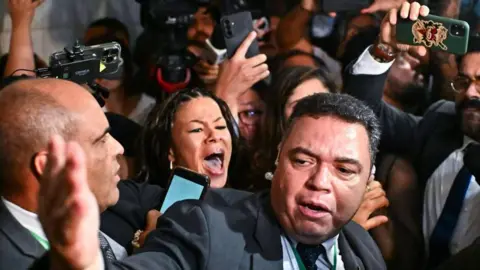
In September 2018, as Jair Bolsonaro campaigned in the south-eastern city of Juiz de Fora, a 40-year-old man pushed through the crowd and stabbed the presidential candidate in the stomach. Images of Bolsonaro doubled over in pain, wearing a T-shirt in Brazil's football colours, were shared millions of times and broadcast endlessly on television.
The former army captain survived, and the shock and commotion caused by the attack boosted his outsider image and helped carry him to victory weeks later.
Seven years on, Brazil's Supreme Court has found him guilty of plotting a coup and sentenced him to more than 27 years in prison. On the face of it, Bolsonaro's career is over. However, he remains one of the most consequential politicians of recent decades, and with allies already pushing for amnesty, his influence and even the prospect of a comeback still hangs over Brazil's future.
The long road to power
Because of his inflammatory rhetoric, Bolsonaro was never taken seriously by most of Brazil's political establishment before becoming president.
In July 2018, three months before the election, I was BBC Brasil's São Paulo bureau chief. In conversations with pollsters, politicians and business leaders, the consensus was clear: despite leading in most polls, Bolsonaro could not win; he lacked the machinery of a major party and his support would quickly fade once television campaigning began.
Bolsonaro was a former army official, who left the forces after campaigning for higher military pay and being accused - then acquitted - of plotting a bombing as part of salary protests in the 1980s.
He then began a three-decade career as a congressman, building a persona on incendiary statements and defence of the military dictatorship that ended in 1985. For decades, he was a constant presence on television talk shows where he railed against democracy and praised authoritarian rule.
In 2018, Brazilians were hungry for an outsider. The country had endured five years of turmoil: mass protests in 2013, a deep recession, and the impeachment of President Dilma Rousseff in 2016. Bolsonaro seized this opportunity and, mostly through social media, managed to assemble a broad coalition to support his candidacy. In October 2018, that coalition turned out in force to vote him into power.
An outsider who changed everything
Bolsonaro managed to turn the Brazilian right into a mass movement for the first time in history, but translating that into an effective government was challenging. His administration was pro-business and allied mainly with the military, leading to an array of controversial policies, including a surge in environmental degradation.
The real challenges came with the pandemic. Bolsonaro's response was characterized by opposition to social distancing measures and his promotion of untested treatments. The consequences were dire, resulting in over 700,000 deaths in Brazil due to COVID-19.
The president's nemesis
During his presidency, Bolsonaro faced staunch opposition from the Supreme Court, particularly from Justice Alexandre de Moraes. Moraes became known for his oversight in political inquiries that posed threats to Brazil's democracy, intensifying tensions between the judiciary and the presidency.
Conspiracy and election controversy
In the lead-up to the October 2022 election, Bolsonaro and his allies fueled conspiracy theories about fraud, questioning the integrity of Brazil's electronic voting system. Despite allegations and some controversial actions on election day aimed against Lula's team, Lula ultimately won the presidency.
Obstinance turns to violence
Following his election defeat, Bolsonaro incited his supporters to dispute the election results, resulting in mass protests and a notable insurrection attempt at key government buildings in early January 2023. While Bolsonaro denied involvement, the repercussions of this event contributed heavily to his ongoing legal troubles.
The end of the line... for now
Bolsonaro's legal challenges culminated in a conviction on multiple charges, barring him from public office until 2060. Nevertheless, he is actively working to reconnect with his base, as attempts for amnesty for his crimes surface. The political landscape in Brazil remains volatile, with questions about Bolsonaro's future continuing to loom large.