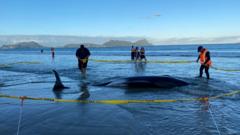
The Department of Conservation (DOC) confirmed that while most of the whales were refloated and returned to the ocean, sadly, three adults and one calf perished during the incident. Fortunately, there were no reports of re-stranding overnight, indicating that the majority of the whales were able to swim clear of danger.
The rescue operation was led by the local Māori group, Patuharakeke, in coordination with various authorities and volunteer community members. Stranding of whales is a puzzling occurrence, and New Zealand is known for having one of the highest rates of such events globally. Volunteers executed the refloating by lifting the whales onto sheets to help them back into the water.
Patuharakeke members stayed on the beach overnight to monitor the situation, ensuring no rescued whale re-stranded. The DOC hailed the rescue as "incredible," highlighting the unity shown by the community in their efforts to safeguard these majestic creatures. Joel Lauterbach, the operations manager for DOC, expressed gratitude to all contributors, including Patuharakeke and Project Jonah, a group focused on aiding stranded marine mammals. He extended his thanks to the hundreds of locals who volunteered to help.
Stranding incidents are common in New Zealand, with an average of around 85 cases reported each year, primarily involving lone animals. Nonetheless, this recent rescue underscores the critical role of both specialized organizations and community members in protecting marine wildlife.
The rescue operation was led by the local Māori group, Patuharakeke, in coordination with various authorities and volunteer community members. Stranding of whales is a puzzling occurrence, and New Zealand is known for having one of the highest rates of such events globally. Volunteers executed the refloating by lifting the whales onto sheets to help them back into the water.
Patuharakeke members stayed on the beach overnight to monitor the situation, ensuring no rescued whale re-stranded. The DOC hailed the rescue as "incredible," highlighting the unity shown by the community in their efforts to safeguard these majestic creatures. Joel Lauterbach, the operations manager for DOC, expressed gratitude to all contributors, including Patuharakeke and Project Jonah, a group focused on aiding stranded marine mammals. He extended his thanks to the hundreds of locals who volunteered to help.
Stranding incidents are common in New Zealand, with an average of around 85 cases reported each year, primarily involving lone animals. Nonetheless, this recent rescue underscores the critical role of both specialized organizations and community members in protecting marine wildlife.