In brief
The hard-right AfD party is expected to emerge as Germany's second-largest political force, signaling a dramatic shift in the nation's political landscape. With growing concerns over migration, a faltering economy, and a weakened military, the party's rise represents both a challenge and a reflection of changing sentiments among voters.
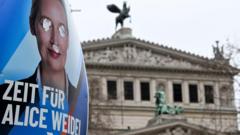
A significant political upheaval is underway in Germany as the hard-right nationalist party, Alternative for Germany (AfD), prepares for what it anticipates to be a monumental electoral breakthrough this Sunday. Opponents label the AfD as "radical," "racist," and even "anti-democratic," while the country’s domestic intelligence agency considers it "anti-constitutional." Nonetheless, recent polls suggest that the AfD may emerge as the second-largest political force within Germany, indicating a seismic shift not only within the nation but across Europe.The rise of the AfD reflects a broader trend of increasing support for populist right-wing parties throughout Europe. The party aligns itself with similar movements, such as the support for Donald Trump's "anti-woke," stringent migration policies, and skepticism towards military aid to Ukraine, alongside a desire to ease tensions with Russia. Trump's public backing of the AfD has further ignited controversy within Germany.Historically, Germany's post-war political landscape has been shaped by its dark past, which seemed to immunize it against extremist ideologies. However, as the AfD continues to gain traction, this assumption is increasingly under scrutiny. Observers are beginning to reassess Germany’s position in relation to the rise of the far-right.The AfD's ascendant popularity comes at a time when Germany grapples with significant economic challenges, leading to a national identity crisis. The fall from grace—where Germany was once seen as Europe's economic powerhouse—can be attributed to a car industry-dependent economy reliant on outdated technologies and manipulated by foreign dependence, particularly post-Angela Merkel’s administration. Inadequate investments in innovation and a growing vulnerability to shifting geopolitical climates have only exacerbated these issues.Moreover, Germany's military status has faced mounting criticism, particularly in light of growing tensions following Russia's invasion of Ukraine. Chancellor Olaf Scholz's acknowledgment of a "turning point" for military capability has yet to materialize, leaving Germany in a precarious position among its NATO partners.The country's deteriorating infrastructure and problems with public transportation showcase chronic under-investment. At the same time, legal limitations on government spending, stemming from the debt brake introduced after the 2008 financial crisis, have further complicated matters, stifling necessary investment for growth and recovery.The issue of migration is particularly resonant in the current political climate. In the aftermath of the European migrant crisis of 2015/16, which saw over a million asylum seekers settle in Germany, the AfD has capitalized on concerns arising from recent violent incidents associated with migrants, shifting the debate on immigration profoundly. While the party insists on a distinction between legal and illegal migration, recent court rulings illustrate a troubling sentiment regarding those with migrant backgrounds.Despite its rising influence, the AfD faces significant hurdles in securing a place within Germany's forthcoming government. Germany's post-war political structure is designed to prevent any single party from gaining undue power; thus, coalition-building remains critical. The established political consensus seeks to exclude the extreme right, a stance that may not easily change with the AfD's growing support.As the election approaches, mainstream parties feel the pressure to adopt more right-leaning rhetoric, reflecting apprehensions about voter losses to the AfD. Despite the party's claims of being a legitimate conservative force, the majority sentiment seems to oppose it, with many citizens advocating for a preservation of the democratic values that define post-war Germany.