
In brief
India faces a crucial moment in its foreign policy as it attempts to balance its relationships with major global powers amid increasing tensions. With Donald Trump's criticism of India's trade relations and the necessity of maintaining ties with both Russia and China, experts are weighing in on how the nation can navigate its strategic autonomy in a multipolar context.
This is a time for us to engage America, manage China, cultivate Europe, reassure Russia, bring Japan into play, draw neighbours in, extend the neighbourhood and expand traditional constituencies of support, Indian Foreign Minister S Jaishankar wrote in his 2020 book The India Way: Strategies for an Uncertain World.
For over a decade, India has styled itself as a key node in a new multipolar order: one foot in Washington, another in Moscow, and a wary eye on Beijing.
But the scaffolding is buckling. Donald Trump's America has turned from cheerleader to critic, accusing India of bankrolling Moscow's war chest with discounted oil purchases. Delhi now faces the sting of Trump's public rebuke and higher tariffs.
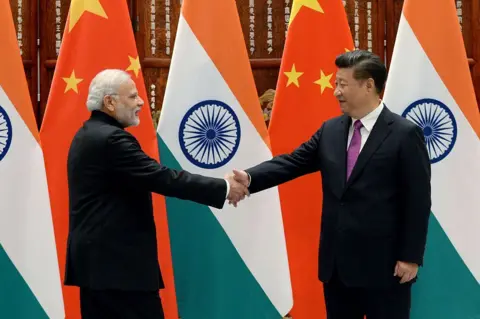
With multipolarity fraying, many say Prime Minister Narendra Modi's planned meeting with Xi Jinping in Beijing in September looks less like triumphal diplomacy and more like pragmatic rapprochement.
Yet, Delhi's foreign policy is at an uneasy crossroads.
India sits in two camps at once: a pillar of Washington's Indo-Pacific Quad with Japan, the US and Australia, and a member of the Shanghai Cooperation Organisation (SCO), the China and Russia-led bloc that often runs counter to US interests. Delhi buys discounted Russian oil even as it courts American investment and technology and prepares to sit at the SCO table in Tianjin next week.
There's also the I2U2 - a grouping of India, Israel, the UAE and the US that focuses on technology, food security and infrastructure - and a trilateral initiative with France and the UAE.
Analysts say this balancing act is no accident. India prizes strategic autonomy and argues that engaging with competing camps gives it leverage rather than exposure.
Hedging is a bad choice. But the alternative of aligning with anyone is worse. India's best choice is the bad choice, which is hedging, Jitendra Nath Misra, a former Indian ambassador, told BBC.
Despite its strategic ambiguities, India's global ambitions continue to exceed its capacities. It is the world's second largest importer of arms and not among the top five arms exporters. This mismatch shapes India's diplomacy, especially in its cautious thawing ties with China following the deadly Galwan clashes of 2020.
Recent comments from Chinese officials in Delhi suggest a push for closer ties, despite the evident concerns and historical tensions that linger between the two nations. Ms. Rao argues that India remains a titan in chrysalis - too substantial and ambitious to align itself unambiguously with one great power. Amid several geopolitical storms, it appears India's path forward relies on a mix of patience and strategic negotiations.

