
In brief
During his inaugural speech, President Trump claimed that China operates the Panama Canal, which has been denied by Panamanian officials who assert their complete control over the waterway. Although China's investment presence in the region raises concerns, it does not equate to ownership.
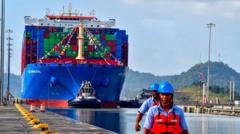
During his recent address, former President Donald Trump reiterated claims suggesting that China is in control of the Panama Canal. He stated, "China is operating the Panama Canal and we didn't give it to China. We gave it to Panama and we're taking it back." This assertion has drawn sharp criticism and clarifications from Panamanian leaders, who maintain that the canal is entirely managed by the Panama Canal Authority, an entity of the Panamanian government.The Panama Canal, which spans 51 miles (82 km), serves as a vital passage connecting the Atlantic and Pacific Oceans, allowing approximately 14,000 ships to circumvent a much longer route around South America each year. Trump’s recent remarks reflect concerns among some US officials regarding Beijing’s significant investments in the region. Previously, Trump had tweeted during the holidays, describing "wonderful soldiers of China" as "illegally" operating the canal, a claim dismissed by Panamanian President José Raúl Mulino as "nonsense."In light of Trump's inaugural address, President Mulino reiterated that no external nation has any interference in the administration of the canal. U.S. control of the canal lasted until 1999 when it was officially handed over to Panama following a treaty signed in 1977 by President Jimmy Carter. The treaty emphasizes the canal’s neutrality, allowing the U.S. to intervene if necessary to protect it.China has emerged as the second-largest user of the canal, accounting for approximately 21.4% of its cargo traffic from October 2023 to September 2024. Chinese companies have also bolstered their presence through investments in critical nearby infrastructure, such as the operation of ports Balboa and Cristóbal, through Hutchison Port Holdings, a Hong Kong conglomerate.While insufficient evidence is available to suggest Chinese control over the canal, experts note that the geopolitical dynamics in play are significant. Ryan Berg from the Centre for Strategic and International Studies points out that the information flowing through these ports could be strategically advantageous for China amid tensions with the U.S.China's growing influence in Panama aligns with its broader strategy to expand its reach across Latin America, a region historically within the sphere of U.S. influence. The establishment of diplomatic ties with China by Panama in 2017 and participation in the Belt and Road Initiative mark critical turning points in this relationship.In conclusion, while concerns persist regarding Chinese investments and their implications for U.S.-Panama relations, the narrative that China operates the Panama Canal remains purely speculative and contested by Panamanian authorities.

