
In brief
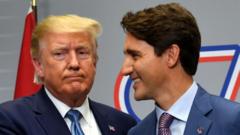
In a bold response to newly imposed tariffs by the Trump administration, Canadian Prime Minister Justin Trudeau accused former President Trump of attempting to undermine the Canadian economy, promising a fierce fight to protect Canada's interests.
Prime Minister Justin Trudeau has sharply criticized former President Donald Trump's recent tariffs on Canada, labeling them as a misguided strategy that aims to "collapse the Canadian economy." During a press briefing, Trudeau emphasized that Trump's actions could potentially pave the way for the annexation of Canada into the United States, a notion he vehemently repudiated, stating: "We will never be the 51st state."The tariffs, set at 25% for various products entering the U.S. from Canada and Mexico, are part of Trump's broader trade measures, which also include increased tariffs on Chinese goods. Trudeau declared that his government will impose retaliatory tariffs on U.S. exports and cautioned that the escalation of these trade tensions would not favor either nation economically."This is a time to hit back hard and to demonstrate that there will be no winners in a trade war with Canada," Trudeau remarked. One of his key objectives remains to ensure the swift removal of tariffs to minimize economic disruptions.Trump has justified his tariffs by claiming that their primary purpose is to protect American jobs and manufacturing from foreign competition, while also attempting to curb illegal migration and opioid trafficking from abroad. In a retort via Truth Social, Trump reinforced his stance by threatening reciprocal tariffs against Canada.Trudeau countered that there is "no justification" for these new levies, particularly since data indicates that less than 1% of intercepted fentanyl at the U.S. border originates from Canada. His concerns were echoed by Mexican President Claudia Sheinbaum, who dismissed Trump's rationale as lacking merit and vowed to implement her own tariff responses shortly.Economic experts express concerns that these tariffs could inflate consumer prices significantly in the U.S. and other affected markets. They predict heightened apprehensions of a trade war as the U.S., Canada, and Mexico engage in a back-and-forth exchange of tariffs.In response to Trump's measures, Canada plans to implement substantial actions, including a reciprocal tariff of 25% on $107 billion worth of American goods. The beginning of these tariffs is scheduled in two phases: one affecting $30 billion of goods immediately and a second phase impacting $125 billion within 21 days.With Canadian industries deeply reliant on trade with the U.S., experts warn that the tariffs jeopardize up to a million Canadian jobs. Various employers, including auto manufacturing workers in Ontario, express fears of job stability due to the implications of the tariffs. "I just bought my first house," said car worker Joel Soleski, as he contemplated the prospect of job loss.Authorities, including Ontario Premier Doug Ford, predict potential shutdowns of assembly plants as businesses on both sides of the border grapple with the economic fallout. The Canadian Chamber of Commerce decried the tariffs as "reckless," cautioning that they could precipitate a recession and significant job losses in both countries.In a display of solidarity, provincial leaders in Canada are devising responses to Trump's tariffs, exploring measures such as restricting electricity exports to the U.S., banning American bids on public contracts, and even cancelling contracts with U.S.-based companies.Meanwhile, in response to the escalating trade war, China has indicated its willingness to retaliate against U.S. tariffs, declaring it would fight back to the "bitter end" with its own tariffs on U.S. agricultural products.
