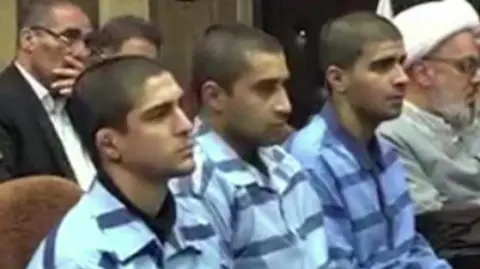
Iran has executed three men accused of killing police officers during anti-government protests in January, state media report. This marks the first executions connected to the protests, which had escalated dramatically across the country.
Among those executed was teenager Saleh Mohammadi, who was noted to be a member of Iran's national wrestling team. The Supreme Court upheld their death sentences before the executions took place on Thursday morning in northern Qom province, as reported by Iran's Tasnim news agency.
The protests, which commenced in December and intensified in January, were met with a brutal crackdown from the Iranian authorities. Rights organizations report that thousands lost their lives during the unrest, with recent claims indicating that at least 7,000 people were killed, including approximately 236 children.
Mohammadi, along with Mehdi Ghasemi and Saeed Davoudi, were found guilty not just of killing two police officers but also of 'moharebeh'—a term that translates to 'waging war against God,' often used in Iran to justify death sentences against dissenters.
Human rights groups have alleged that the three were forced to confess under duress and were not provided a fair trial before their execution. Tasnim also noted that the judiciary's accusations stemmed from separate attacks in which the police were killed.
This execution follows another recent hanging of Kouroush Keyvani, a dual Iranian-Swedish national accused of spying for Israel. Sweden's foreign minister criticized the legal process surrounding Keyvani's execution, echoing concerns about the integrity of trials in Iran.
The violent protests that broke out were originally sparked by severe economic challenges, including the plummeting Iranian currency and skyrocketing living costs, and soon escalated into calls for political reform. These demonstrations are being seen as one of the most significant challenges faced by Iran's clerical regime since the Islamic Revolution of 1979.
As the Iranian government continues its crackdown on dissent, observers note an evident pattern of heightened repression in response to burgeoning civil unrest.