In brief
Oh Seung-geol, the chief of South Korea's Suneung college entrance exam, has resigned amid severe criticism over this year's notoriously difficult English test. The test, filled with what many perceived as confusing and convoluted questions, sparked outrage from students and educators alike, leading to discussions about the effectiveness of the exam's structure. While some believe the test serves its purpose in measuring comprehension, others argue it undermines real educational value.
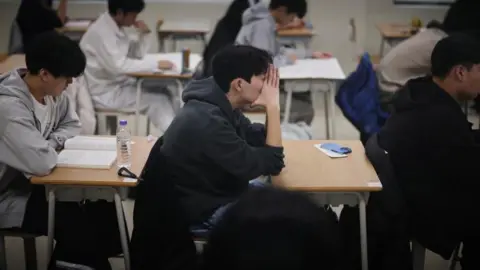
The English section of South Korea's gruelling college entrance exam, or Suneung, is notoriously difficult, with some students comparing it to deciphering an ancient script, and others calling it 'insane'. So intense was the criticism around this year's test that the top official in charge of administering it resigned to take responsibility for the 'chaos' it caused.
'We sincerely accept the criticism that the difficulty of questions... was inappropriate,' said Suneung chief Oh Seung-geol, adding that the test 'fell short' despite having gone through several rounds of editing.
Among the most daunting questions are one on Immanuel Kant's philosophy of law and another involving gaming jargon. The latter, worth three points, asks students to pick where a sentence should fit in a given paragraph. Here's the sentence in bold, followed by the paragraph:
The difference is that the action in the game world can only be explored through the virtual bodily space of the avatar.
A video game has its own model of reality, internal to itself and separate from the player's external reality...
The correct answer is 3. Many have criticised the way this and several other questions were worded. One user on Reddit called it 'fancy smart talking' while another said it was 'awful writing [that] doesn't convey a concept or idea well'.
Students are given 70 minutes to attempt 45 questions. Just over 3% of this year's test-takers scored the highest grade for the English section, compared to 6% last year. 'It took me a long time to figure out several questions and understanding the texts themselves was tricky... [Some] answers looked similar to each other,' said Im Na-hye, a senior at Hanyeong High School.
But English language professor Jung Chae-kwan says it is a misnomer to call the English test tough. 'The texts aren't necessarily impossible, but... maddeningly confusing. It's a pain because it makes the material useless for actual education,' said Prof Jung.
Some educators argue that the difficulty of the Suneung reflects its intended purpose, measuring reading comprehension skills necessary for higher education. However, given its intense pressure on students and broader societal implications, many are calling for a reevaluation of its design and implementation.
Only four of the 12 Suneung chiefs since the exam debuted in 1993 have served out their full three-year terms, with Mr. Oh being the first to resign due to test difficulty rather than errors in questions.