
In brief
Following another round of seismic activity in the Aegean Sea, residents brace for more potential earthquakes as authorities issue warnings and state of emergency in Santorini continues.
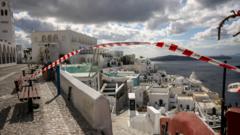
The Greek island of Santorini was shaken by a robust 5.3 magnitude earthquake on Monday evening, the strongest in a series of tremors that have unsettled the area recently. This quake, with a focal depth of 17km (10.6 miles), rippled through the island and was even felt in nearby Athens. The seismic crisis has escalated over the past two weeks, with the island registering more than 12,800 tremors since January, according to the University of Athens' Seismological Laboratory.The latest seismic event followed a moderate 5.0 magnitude quake reported just the evening prior. In the wake of these tremors, residents on the neighboring island of Amorgos remain vigilant, with authorities encouraging caution in popular but perilous areas, where landslides have occurred. The frequent tremors have prompted some local inhabitants to patrol cliffs and deter tourists from taking photos in dangerous locations.Despite the intensity of the earthquakes, inspections indicated no structural damage to buildings on Santorini or Amorgos, and no injuries have been reported. Nonetheless, the upheaval has led to the evacuation of more than 11,000 residents from the islands, with schools remaining closed in Santorini, Amorgos, and other neighboring islands over the coming days.The Greek government has initiated a state of emergency on Santorini, which is set to remain in effect until at least March 3. A team from the Special Disaster Response Unit is being dispatched to Amorgos, equipped with specialized earthquake rescue vehicles, while technical crews are expected to evaluate the island's electrical infrastructure.Kostas Papazachos, a seismology professor at the Aristotle University of Thessaloniki, commented on the current situation, expressing hope for a gradual easing of seismic activity. However, he acknowledged that the possibility of a more significant earthquake cannot entirely be dismissed.As fears continue, tourism remains impacted; the cruise ship Viking Star, with a passenger and crew total of 1,363, altered its course to avoid Santorini, primarily due to concerns over overcrowding at cable car operations during the tremor episodes. In historical context, Greece ranks as one of Europe's most seismically active regions, and scientists remain puzzled by the series of quakes that have occurred without a corresponding larger seismic event. While Santorini sits on the Hellenic Volcanic Arc, known for its volcanic history, the recent tremors have been attributed to tectonic plate movements rather than volcanic activity. As the scientific community studies this ongoing seismic phenomenon, the uncertainty looms over the potential for further geological events in the area.
