In brief
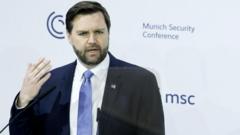
During his address at the Munich Security Conference, US Vice-President JD Vance criticized European governments for failing to uphold democratic principles, focusing on free speech and migration, while leaving many attendees in shock and prompting a backlash from various political figures.
US Vice-President JD Vance stirred controversy during his recent speech at the Munich Security Conference, asserting that the primary threat to European democracies stems from within rather than external forces such as Russia and China. Contrary to expectations of discussing potential peace talks in Ukraine, Vance's remarks focused heavily on accusations against European governments—including the UK—for neglecting voter concerns regarding migration and free speech.The response from the audience was muted, and multiple politicians at the conference rebuked Vance's opinions. German Defence Minister Boris Pistorius described Vance's perspective as "not acceptable." Vance continued to echo sentiments from the Trump administration, urging Europe to enhance its self-defense capabilities in light of current geopolitical tensions.Although he mentioned the conflict in Ukraine and expressed hope for a "reasonable settlement," Vance quickly pivoted to address cultural issues that align with Trump’s campaign themes. He criticized European Union regulations that he claims undermine free speech, pointed fingers at Europe for its migration challenges, and contended that leaders were stepping away from fundamental democratic values.EU foreign policy chief Kaja Kallas characterized Vance's assertions as confrontational, while former US ambassador to Russia, Michael McFaul, labeled Vance's statements as "insulting" and lacking factual basis. Vance cited examples in various European nations, particularly highlighting a legal case in the UK where an army veteran was convicted for silently praying outside an abortion clinic—an act he claimed jeopardizes "the basic liberties of religious Britons."With Germany on the brink of a tense national election, Vance also criticized the consensus among major political parties to avoid collaboration with the far-right Alternative for Germany (AfD) party. He argued against what he termed a "firewall," stating, "Democracy rests on the sacred principle that the voice of the people matters." Pistorius directly rebutted Vance by denouncing the Vice-President's characterization of European democracy, emphasizing that he found it unacceptable to compare European conditions to those of authoritarian regimes.Vance brought attention to the electoral instability in Romania caused by alleged Russian interference and stressed that democracy cannot be weakened by such external influences. Romanian Prime Minister Marcel Ciolacu reiterated his nation's commitment to safeguarding democratic values, stating that authorities aim to ensure free and fair elections.In a notable moment at the conference, Vance held discussions with Ukrainian President Volodymyr Zelensky, who underscored the need for progress toward resolving the ongoing conflict while Vance described their dialogue as "fruitful". While ex-president Trump had anticipated a convergence of US, Russian, and Ukrainian officials in Munich, Moscow announced it would not be participating in the summit, further raising questions about the future of international relations and security strategies in the region.