
In brief
The successful data capture by India's space mission Aditya-L1 is pivotal for studying coronal mass ejections, which can disrupt technology on Earth and in space. This achievement positions India as a key player in solar research, bolstering global efforts to anticipate and mitigate the effects of solar storms.
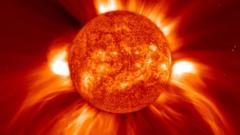
Scientists in India have unveiled a breakthrough from the country's inaugural solar mission, Aditya-L1, which aims to deepen our understanding of solar dynamics and its implications for Earth. The mission's principal component, a device termed the Visible Emission Line Coronagraph (Velc), recently captured crucial data on a coronal mass ejection (CME) that occurred on July 16. CMEs are colossal bursts of solar wind and magnetic fields rising above the solar corona or released into space, posing various risks to our technological infrastructure.According to Prof. R. Ramesh of the Indian Institute of Astrophysics, who oversees the Velc project, the CME studied originated on the sun's Earth-facing side but veered away, avoiding any impact on our planet. However, the potential threat such particles pose cannot be overstated; they can travel at speeds nearing 3,000 kilometers per second, enabling them to reach Earth in a mere 15 hours.The implications of understanding CMEs are profound. While these solar eruptions often create stunning auroras, they are equally capable of wreaking havoc on communication systems, satellite operations, and even power grids here on Earth. The 1989 solar storm that plunged Quebec into darkness for nine hours serves as a stark reminder of this vulnerability; in recent incidents, solar activity has disrupted air traffic control in Europe, highlighting a clear need for improved monitoring capabilities.Aditya-L1 positions India alongside established leaders in solar observation, such as NASA and ESA. Utilizing its unique placement in space, the mission can continuously monitor solar activity, a significant advantage over ground-based observatories that can only capture fleeting moments of solar phenomena during total eclipses. Furthermore, Velc's innovative design allows unprecedented observations, enabling scientists to track the genesis and trajectory of CMEs more effectively than ever before.India’s broader network of solar observatories, coupled with the Aditya-L1 data, emphasizes a collaborative approach to solar research, enhancing global capacity to predict and respond to solar activities. Prof. Ramesh notes that by synchronizing observations from various sources, scientists can develop a more nuanced understanding of solar behavior and its ramifications for Earth and the entire solar system.As nations increasingly depend on satellite communication and infrastructure, India's advancements in solar preparedness through the Aditya-L1 program not only elevate its scientific stature but also contribute fundamentally to international efforts in reducing the impacts of solar weather on daily life and technology.
