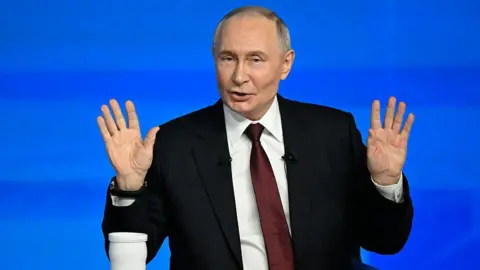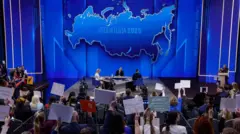
Russian President Vladimir Putin has asserted that there will be no further wars following the conflict in Ukraine if Russia is treated with respect. He dismissed claims of Moscow’s intent to attack European nations as 'nonsense' during a nearly four-and-a-half-hour televised event with the BBC.
Putin responded affirmatively to a question regarding the potential for more military operations, stipulating, 'There won't be any operations if you treat us with respect, if you respect our interests just as we've always tried to respect yours.' His remarks come amid ongoing tensions in Ukraine, where recent missile strikes claimed lives.
He previously stated, 'Russia is not planning to go to war with Europe, but is ready "right now" if Europeans wanted to.' Putin's comments were also framed by his long-standing grievances against NATO, particularly its eastward expansion, which he claims undermines Russian security.
As part of his marathon appearance, Putin showcased the Kremlin's narrative, stating that the absence of wars is contingent upon mutual respect and adherence to previously agreed standards between nations. He also linked potential future peace efforts to the West ceasing what he perceives as betrayal, notably referencing alleged commitments made in the early 1990s.
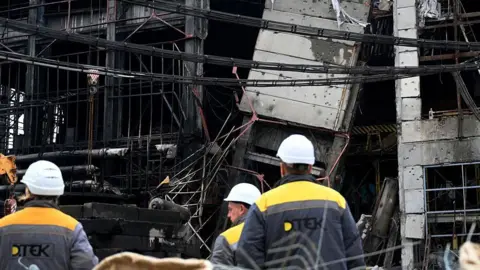
The broadcast coincided with serious military developments, including a recent Russian missile attack that resulted in fatalities in Ukraine. Putin's right to engage in negotiations, particularly around NATO and security assurances in Eastern Europe, remains a theme throughout his responses, coupled with dismissals of Western intelligence warnings regarding future Russian aggression.
Despite asserting peace readiness, Putin maintained his demands for complete control over occupied Ukrainian territories as a condition for relaxing hostilities. His habitual narrative positions the conflict in a nationalistic light, framing it as a defense against perceived Western threats rather than an aggression stemming from Russia's actions.
In closing, Putin claimed advancements on the battlefield in Ukraine while challenging the Ukrainian government’s capabilities. He continues to emphasize an image of Russia as a nation standing firm against Western oppression, framing the dialogue with the West as crucial for future peace but asserting that compromises depend heavily on respect and recognition from NATO.
Putin responded affirmatively to a question regarding the potential for more military operations, stipulating, 'There won't be any operations if you treat us with respect, if you respect our interests just as we've always tried to respect yours.' His remarks come amid ongoing tensions in Ukraine, where recent missile strikes claimed lives.
He previously stated, 'Russia is not planning to go to war with Europe, but is ready "right now" if Europeans wanted to.' Putin's comments were also framed by his long-standing grievances against NATO, particularly its eastward expansion, which he claims undermines Russian security.
As part of his marathon appearance, Putin showcased the Kremlin's narrative, stating that the absence of wars is contingent upon mutual respect and adherence to previously agreed standards between nations. He also linked potential future peace efforts to the West ceasing what he perceives as betrayal, notably referencing alleged commitments made in the early 1990s.
The broadcast coincided with serious military developments, including a recent Russian missile attack that resulted in fatalities in Ukraine. Putin's right to engage in negotiations, particularly around NATO and security assurances in Eastern Europe, remains a theme throughout his responses, coupled with dismissals of Western intelligence warnings regarding future Russian aggression.
Despite asserting peace readiness, Putin maintained his demands for complete control over occupied Ukrainian territories as a condition for relaxing hostilities. His habitual narrative positions the conflict in a nationalistic light, framing it as a defense against perceived Western threats rather than an aggression stemming from Russia's actions.
In closing, Putin claimed advancements on the battlefield in Ukraine while challenging the Ukrainian government’s capabilities. He continues to emphasize an image of Russia as a nation standing firm against Western oppression, framing the dialogue with the West as crucial for future peace but asserting that compromises depend heavily on respect and recognition from NATO.