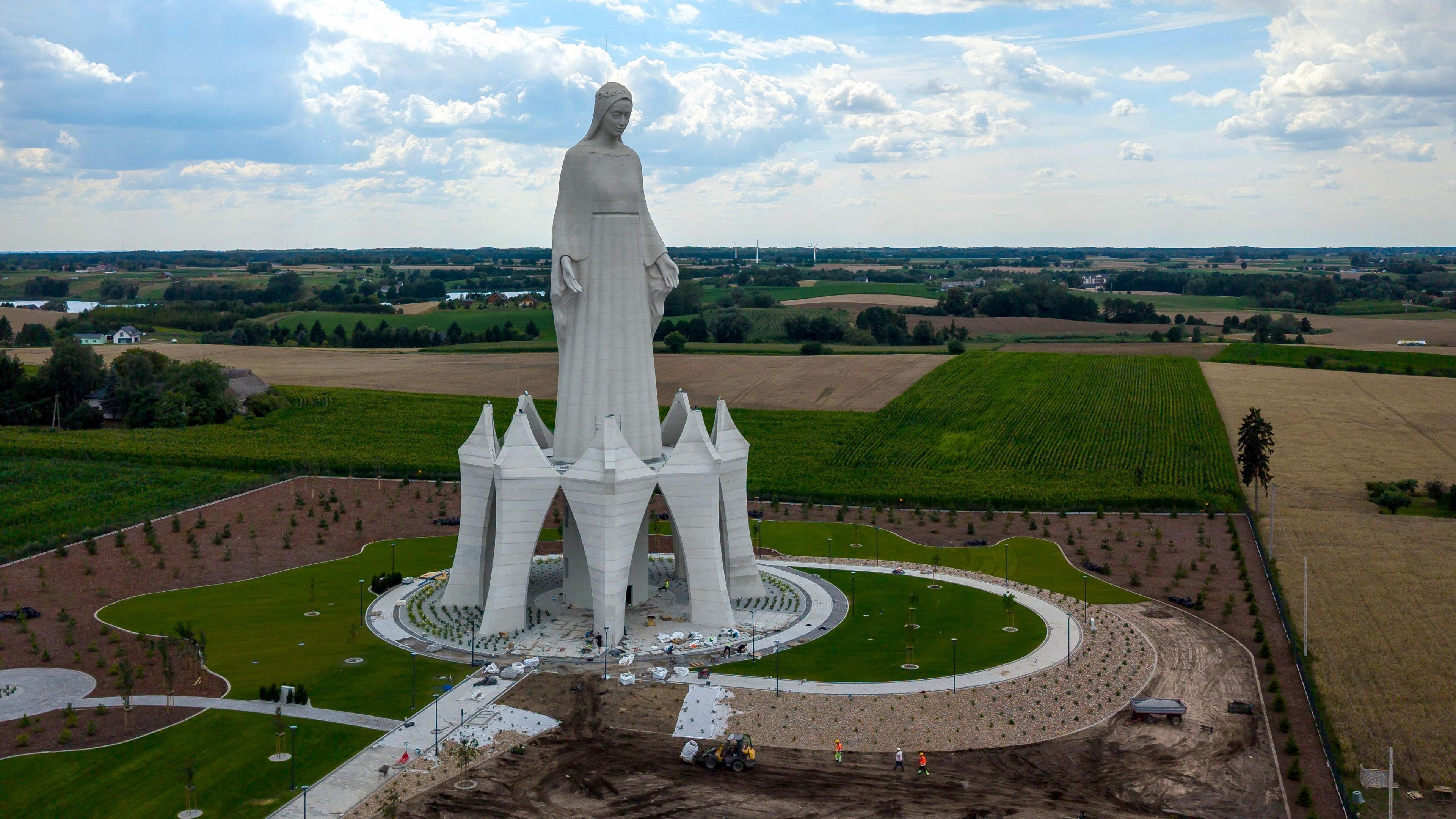
A towering 55.6‑metre concrete Virgin Mary statue has been unveiled in the agricultural hamlet of Konotopie, sloping up from green fields and taking up space in a nation where religion is a familiar, yet contested, backdrop. The monumental statue, taller than Rio’s Christ the Redeemer by nearly 18 metres, was consecrated on Saturday in a ceremony that timed the unveiling with the Feast of the Assumption, a day sacred to many Catholics.
The sculpture’s remote placement — a field miles from the nearest town — owes to a partnership between a local millionaire couple and the bishop’s office. Helicopters circled above to shower rose petals, creating a vivid spectacle as the Virgin Mary’s large crown and open arms seemed to beckon the sky.
Bishop Krzysztof Wętkowski addressed the gathered crowds, noting how many modern people concentrate on earthly concerns and urging the faithful to lift their gaze higher: “to God and heaven.” These words echo amidst a Poland where younger generations appear increasingly distant from longstanding church traditions, even as the country remains predominantly Catholic.
Among the attendees was former president Lech Wałęsa, famed for his role in the anti‑communist opposition and his lifelong devotion to Catholic faith, who was quoted saying, “I started with the Virgin Mary and I end with the Virgin Mary.” The presence of such a pivotal political figure underscores the intertwining of faith and national identity in contemporary Poland.
The statue not only raises questions about the relevance of grand religious monuments in a modern, secularizing society, but also invites reflection on how faith can adapt without losing its symbolic power. As the village’s quiet fields now house a towering emblem of belief, the debate continues over whether such monumental expressions of faith can resonate with a generation that increasingly turns away from organized religion.