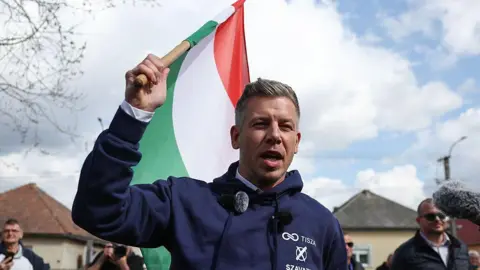
Now or never, Peter Magyar declares as he embarks on an intense campaign trail for the upcoming April 12 elections. This former insider of Viktor Orban's Fidesz party now represents the most significant challenge to Orban's decade-long rule, one that began in 2010. The 45-year-old Magyar's battle cry, echoing a 19th-century revolutionary poet, has transformed to simply Now, emphasizing the urgency of political change in Hungary.
After conducting over 100 campaign stops, Magyar claims to connect with the citizens, focusing on crucial issues like corruption and the economy, and trying to appeal to the historically Fidesz-supportive communities. His commitment extended to a 300 km walk from Budapest to the Romanian border last year, highlighting a desire to reunite Hungary.
Through promises to unlock European Union funds and address the needs of the disadvantaged Roma community, Magyar's political aspirations aim to bridge the gap left by the allegations of corruption plaguing the current regime. However, Orban's counterattacks rarely miss, portraying Magyar as a mere puppet of foreign powers.
Until recently, Magyar was an integral part of the Fidesz circle, deeply connected to its ecosystem through his marriage to party leader Judit Varga. His abrupt departure from the party has already turned heads, especially after a viral interview on a popular opposition channel, where he critically outlined the failures of his former colleagues.
Hungary is currently reeling from a political scandal involving the pardon of a prominent abuser, further straining the government’s credibility. Magyar stridently criticized both the ruling party’s management and indicated a need for a structural shift, which he aims to catalyze via his new party, Tisza.
As the elections approach, the pressure intensifies. Magyar’s grassroots momentum suggests that a true rivalry is brewing. This is not merely about one politician's ambition, but rather a transformative moment for Hungarian politics—an opportunity to challenge the long-held grip of Orban's governance, as echoed through Magyar's reiteration: This is a once-in-a-lifetime opportunity, not for Peter Magyar but for the country.\
After conducting over 100 campaign stops, Magyar claims to connect with the citizens, focusing on crucial issues like corruption and the economy, and trying to appeal to the historically Fidesz-supportive communities. His commitment extended to a 300 km walk from Budapest to the Romanian border last year, highlighting a desire to reunite Hungary.
Through promises to unlock European Union funds and address the needs of the disadvantaged Roma community, Magyar's political aspirations aim to bridge the gap left by the allegations of corruption plaguing the current regime. However, Orban's counterattacks rarely miss, portraying Magyar as a mere puppet of foreign powers.
Until recently, Magyar was an integral part of the Fidesz circle, deeply connected to its ecosystem through his marriage to party leader Judit Varga. His abrupt departure from the party has already turned heads, especially after a viral interview on a popular opposition channel, where he critically outlined the failures of his former colleagues.
Hungary is currently reeling from a political scandal involving the pardon of a prominent abuser, further straining the government’s credibility. Magyar stridently criticized both the ruling party’s management and indicated a need for a structural shift, which he aims to catalyze via his new party, Tisza.
As the elections approach, the pressure intensifies. Magyar’s grassroots momentum suggests that a true rivalry is brewing. This is not merely about one politician's ambition, but rather a transformative moment for Hungarian politics—an opportunity to challenge the long-held grip of Orban's governance, as echoed through Magyar's reiteration: This is a once-in-a-lifetime opportunity, not for Peter Magyar but for the country.\