In brief
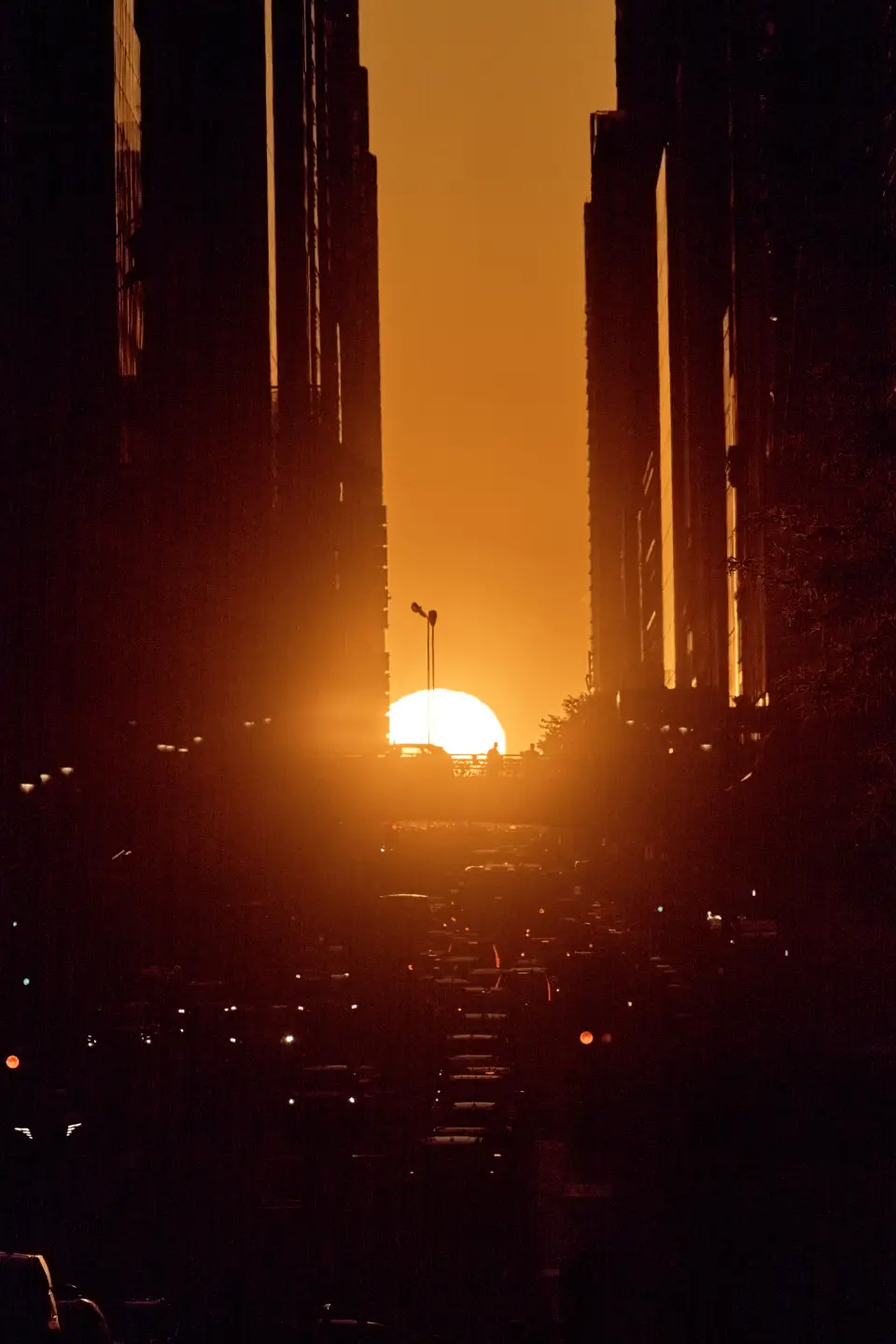
In late June, New York’s grid of east‑west streets aligns with the setting sun, creating a stunning silhouette of skyscrapers framed by the light. Known as Manhattanhenge, this bi‑annual event draws crowds to 14th, 23rd, 34th, 42nd, and 57th streets. While the phenomenon isn’t officially organized, it’s a must‑see for photographers and city lovers alike. Similar alignments appear in Chicago and Baltimore at other times of year.
NEW YORK (AP) – The city skyline becomes an architectural light show twice a year, as the setting sun lines up perfectly with Manhattan’s east‑west street grid. Known as Manhattanhenge, the event is a dramatic sun‑setting spectacle that attracts photographers, tourists, and sunrise‑seekers alike.The most recent alignment happened Thursday, June 28, 2026, when the sun hovered just above the Hudson River horizon, with half of it still in the sky. A fuller version, in which the entire sun appears to hover between skyscrapers, is slated for Friday, June 29. The event will last until the sun sets at a 6:30 p.m. local time, before the streets fade into evening shadows.Manhattanhenge does not occur on the summer solstice itself (which falls on June 21); instead, it peaks about three weeks before and after that date. This is when the sun’s azimuth aligns with the city’s grids of 14th, 23rd, 34th, 42nd, and 57th streets, creating a tilted line of light that slices the cityscape.The phenomenon is named after Stonehenge, thanks to astrophysicist Neil deGrasse Tyson. In a 1997 piece in Natural History magazine, Tyson noted that the setting sun framed by New York’s skyscrapers reminded him of how the rays fell on Stonehenge’s stones during the solstice. Though Manhattan’s grid was never explicitly designed for this optical trick, the numbers line up perfectly.Typical viewing spots are on the wide avenues themselves—think 14th and 34th—where the sun’s beam runs between the tall facades. For those who can tolerate a little travel, the Long Island City waterfront provides a compelling backdrop overlooking the Hudson.While some folks assemble in volunteer “photo‑parks” and even brave cold weather, the event isn’t officially organized. Weather plays a huge role; rain or clouds can obscure the alignment, and the best light is achieved a few minutes before sunset.Other cities with uniform street grids generate similar sunsets. Chicago, Baltimore, and Toronto enjoy their own “henge” celebrations in March, September, February, and October. However, Manhattan’s skyscrapers and unobstructed river view make its configuration uniquely striking.For those planning to catch the sunset, the best tip is to arrive half an hour before the scheduled alignment time, bring a camera, and find a spot on the street with unobstructed lines to the skyline. The next window for Manhattanhenge will appear around June 28–29 and then again on July 11–12, offering two chances to experience this dazzling light show.