
In brief
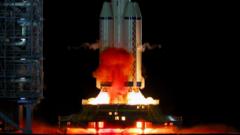
In a historic launch, China's Shenzhou 19 mission sent three young taikonauts towards the Tiangong space station, marking a significant moment for the nation's rapidly advancing space ambitions. This launch has drawn attention both domestically and internationally, particularly as it positions China in a competitive race with the United States for lunar exploration and potential resource control.
The ground shakes with the power of the rocket as it lifts off from the Jiuquan Satellite Launch Center in Gansu, witnessing a spectacle that unites the nation under the banner of pride in its space program. The crew, comprising three taikonauts — including China's first female space engineer, Wang Haoze — reflects a generational shift in China's space endeavors, as they prepare for a six-month mission conducting research and experiments aboard the Tiangong space station.While President Xi Jinping has emphasized the importance of building a strong space presence and achieving lunar aspirations by 2030, US officials view China's ambitions with skepticism. NASA's Administrator Bill Nelson has expressed concerns about China's dual-purpose space program, suspecting it serves military objectives as well. The competitive narrative is further fueled by China's recent successes, including the retrieval of samples from the Moon's far side and the deployment of a Mars rover, all of which have shifted attention to issues of territoriality and resource control in cosmic pursuits.The recent launch also highlights China's intention to foster a new generation of space pioneers, as taikonauts like Song Lingdong draw inspiration from their predecessors and express a commitment to elevating China’s status in space. While domestic celebrations and decorations decorate launch areas, the strategic implications of this mission loom large on the international stage.Experts warn of the new space race, which is evolving from mere exploration to a battle for lunar resources, including rare metals and helium isotopes. As both China and the US stake claims, the ongoing tension raises questions about future collaborations and conflicts beyond Earth's boundaries.Despite invoking a message of peace and international cooperation, Chinese officials acknowledge the need for secrecy and vigilance about emerging technologies. With astronomical investments and aspirations, both nations are now competing in a highly volatile arena that could define future interstellar strategies and territorial claims.The Shenzhou 19 launch not only underscores the technological advancements and aspirations of China's space program but also highlights the underlying geopolitical tensions that accompany such progress, making the future of space exploration a closely watched arena for global watchers. China's continued strides in space, juxtaposed with US apprehensions, indicate that the new frontier of exploration is not merely cosmic — it is also deeply rooted in national pride and geopolitical strategy.
